



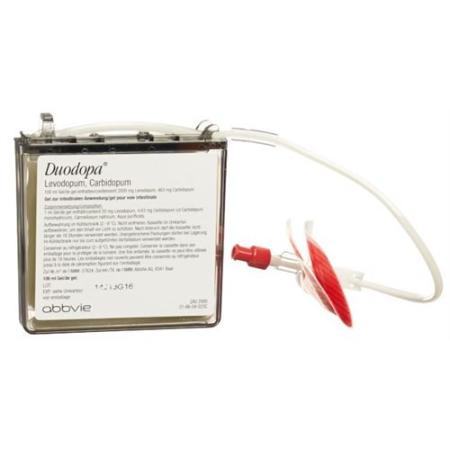
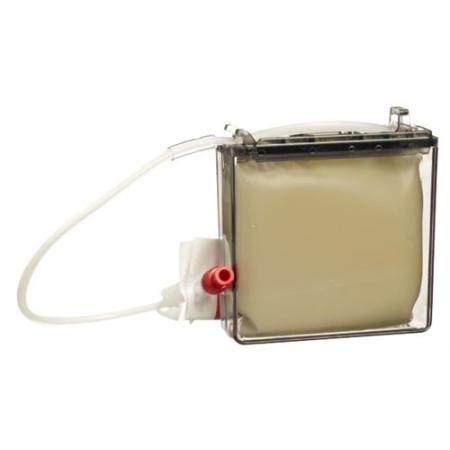
Duodopa Gel 7 bags 100 ml
Duodopa Gel 7 Beutel 100 ml
Send a request to get a price
In stock 2 pcsDescription - Duodopa Gel 7 bags 100 ml
What is Duodopa and when is it used?
Duodopa is a combination of levodopa and carbidopa, drugs used to treat Parkinson's disease. Levodopa is converted into dopamine in the body, a substance found in the brain and spinal cord that helps nerve cells pass through impulses. Too little dopamine can lead to the symptoms associated with Parkinson's disease, such as tremors, stiffness, slow movements, difficulty maintaining balance. Treatment with levodopa increases the amount of dopamine and thus reduces these symptoms.Carbidopa is added to improve the effects and reduce the side effects of levodopa.Duodopa is a gel for intestinal use that is administered directly into the duodenum using a pump through a probe. This means that the active ingredients are continuously supplied in small doses. As a result, the blood level of the drug remains more constant and the risk of side effects, such as movement disorders, is reduced.Duodopa is used to treat advanced, levodopa-responsive Parkinson's disease with severe symptoms when available combinations of anti-Parkinson?s drugs have not produced satisfactory results.A test of positive clinical improvement after Duodopa administered via a nasoduodenal provisional tube is required before an indwelling tube is inserted.Prescriptened by your doctor.
When should Duodopa not be used?
Duodopa must not be used and you must tell your doctor:
- if you are allergic to levodopa, carbidopa or any of the other ingredients of Duodopa;if you have glaucoma (glaucoma);if you have severe liver or kidney problems;if you have severe heart failure;if you have severe irregular heartbeat;if you are suffering from an acute stroke;if you are taking certain medicines called non-selective monoamine oxidase (MAO) inhibitors and selective type A MAOIs (e.g. moclobemide, used to treat depression). Its administration must be discontinued at least 2 weeks before starting Duodopa treatment;if you have had skin cancer in the past or if you have suspicious moles or skin changes that have not been clarified by your doctor;if you suffer from a disease in which certain drugs (sympathomimetics) must not be given, e.g. a tumor of the adrenal gland, hyperthyroidism or Cushing's syndrome.
When should you be careful when using Duodopa?
Take special care with Duodopa:
- if you have severe cardiovascular or lung diseases, bronchial asthma, liver or kidney disease or hormonal disorders;if you have ever had a stomach ulcer or seizure;if you have ever had a serious mental illness;if you feel depressed, have thoughts of suicide or notice unusual changes in behavior;if you have chronic wide-angle glaucoma, your doctor may adjust the dose you have been prescribed. Your intraocular pressure must also be monitored;if you are taking other medicines that may lower blood pressure. Duodopa can potentially make these reactions worse;If you experience sudden episodes of sleep or if you feel very drowsy, you should refrain from driving a car or using tools and machines (see also section ?Driving and using machines?);if you experience severe muscle stiffness, severe muscle twitching, tremors, agitation, confusion, fever, fast heartbeat or significant fluctuations in your blood pressure (signs of neuroleptic malignant syndrome). Tell your doctor about this immediately;if you want to stop treatment with Duodopa, please inform your doctor beforehand. Duodopa may need to be gradually discontinued and your other anti-Parkinson's medication adjusted to prevent side effects or worsening of your Parkinson's symptoms.
Movement disorders may occur with Duodopa, which require the treating doctor to adjust the dose.Duodopa is not recommended for the treatment of drug-induced extrapyramidal reactions.During long-term treatment, it is recommended that liver and kidney function, as well as the function of blood-forming organs and the cardiovascular system, be checked regularly by the attending physician.Some patients have shown unusual behavior for them while taking medicines from the same and related class of substances as Duodopa. Examples of such behavior are an unusually strong urge to play, increased spending, shopping addiction, increased sex drive, excessive eating, binge eating and / or other impulse control disorders (inability to withstand sudden impulses) or addictive behavior or compulsive behaviors.If you or your family members are developing behavior that is atypical or unusual for you, please discuss this with your doctor.Tell your doctor or health care professional if you or your family / caregiver notice that you develop addiction-like symptoms that lead to craving for high doses of Duodopa and other medicines used to treat Parkinson's disease (known to as dopamine dysregulation syndrome).Duodopa contains a substance called hydrazine, a breakdown product of one active ingredient (carbidopa). This substance can cause genetic damage that could theoretically lead to cancer. The risk to people exposed to hydrazine at normal doses with Duodopa is unknown.Children and adolescentsDuodopa is not suitable for use in children and adolescents under 18 years of age as the indication does not justify the use of Duodopa in children and adolescents.
Driving and using machines
Duodopa can cause drowsiness (drowsiness) and / or sudden episodes of sleep. You should therefore neither drive a vehicle nor operate tools or machines or perform other activities in which you or others are exposed to the risk of serious injury or death (e.g. when operating machines) due to impaired alertness until these recurring episodes or the Drowsiness are gone.
Interactions with other drugs
Caution should be exercised if Duodopa is used concomitantly with the following medicines:
- Medicines for high blood pressure (antihypertensive drugs);Certain medicines used to treat depression (tricyclic antidepressants);Certain medicines that work similarly to levodopa (anticholinergics);Dopamine receptor antagonists (e.g. phenothiazines, butyrophenones, risperidone to treat mental illness or metoclopramide to treat nausea and vomiting);Benzodiazepines;Isoniazid;Phenytoin and papaverine;Selegiline;COMT (catechol-O-methyltransferase) inhibitors (tolcapone, entacapone);Amantadine;Sympathomimetics.
Concomitant use of iron sulfate and levodopa / carbidopa leads to a lower absorption of levodopa into the blood.
Using Duodopa with food and drink
Since levodopa competes with certain amino acids, the absorption of levodopa into the blood can be impaired in a protein-rich diet (e.g. meat, fish, dairy products, nuts).The consumption of fiber-rich, hard-to-digest food (e.g. asparagus) should be avoided, as this can lead to blockage of the tube and / or the duodenum in individual cases.This medicinal product contains 277.4 mg sodium per 100 ml cartridge, corresponding to 13.9% of the WHO recommended maximum daily dietary sodium intake for an adult. Talk to your doctor or pharmacist or Your doctor or pharmacist if you need more than one 100 ml cassette of Duodopa per day for a long period of time, especially if you are on a low-sodium diet.Tell your doctor or pharmacist if you have
- suffer from other diseases,have allergies ortake other medicines (including those you have bought yourself) or use them externally.
Can Duodopa be used during pregnancy or breastfeeding?Pregnancy
If you are pregnant or suspected of being pregnant, talk to your doctor or health care professional before using Duodopa.Duodopa must not be used during pregnancy unless clearly necessary.
Breastfeeding
Duodopa should not be used during breast-feeding.
How do you use Duodopa?
Duodopa is used intestinally, ie the gel is administered directly into the duodenum using a pump through a probe. Only the CADD Legacy 1400 Pump (CE marked) should be used to administer Duodopa. A manual with instructions for using the portable pump is provided with the pump.Your doctor will determine the dose you need.A higher morning dose (bolus dose) is usually administered with the pump so that the correct concentration in the blood is reached quickly. A lower maintenance dose is then given. Extra doses can be given if necessary.If the patient is suspected or diagnosed with brain dysfunction, the pump should only be handled by nursing staff who are experienced in operating the pump.Do not change the prescribed dosage on your own. If you think that the medicine is too weak or too strong, talk to your doctor or pharmacist.Do not stop treatment without first asking your doctor.Treatment with Duodopa should not be stopped suddenly, as this may worsen the symptoms of Parkinson's disease.If you use more Duodopa than you should:If you have used too high a dose of the medicine, you must always contact your doctor or a hospital.The use and safety of Duodopa in children and adolescents has not been established.
What side effects can Duodopa have?
Side effects that are common with levodopa / carbidopa are those that are due to the central neuropharmacological activity of dopamine. These reactions can usually be reduced by reducing the dose of levodopa.Please notify your doctor immediately if you notice any of the following symptoms:
- Swelling of the face, tongue or throat making it difficult to swallow or breathe, hives: these symptoms could be signs of an allergic reaction (angioedema).Fever, sore throat and / or tonsillitis: these symptoms could be signs of a change in the number of white blood cells (agranulocytosis). Your doctor will check your blood count .
The following side effects have been seen with Duodopa:Very common (affects more than 1 in 10 people)
- Involuntary, uncontrollable movements;Nausea.
Common (affects 1 to 10 users in 100)
- Decreased appetite, weight loss, vitamin B6 and vitamin B12 deficiency;Hallucinations, confusion, abnormal dreams, sleep attacks, insomnia, sleep disorders, anxiety, depression, agitation, impulsive behavior, psychotic disorders;Dizziness, uncontrollable muscle spasms of the eyes, neck, neck and body, headache, tingling, numbness, painful burning sensation, muscle weakness, worsening Parkinson's disease, tremor, alternating phases of good mobility and immobility;Palpitations, irregular heartbeat;Low blood pressure, drowsiness, especially when changing position quickly (orthostatic hypotension);Drowsiness, tendency to faint, short-term unconsciousness (syncope);Shortness of breath;Lung infection;Constipation, diarrhea, vomiting, dry mouth, gas, bloated stomach, indigestion, taste disturbances;Contact eczema, increased perspiration;Muscle cramps, neck pain;Exhaustion, pain;Increased falls.
Uncommon (affects 1 to 10 users in 1,000)
- Changes in the number of certain blood cells (leukopenia, anemia);Weight gain;Disorientation, euphoria, increased libido, decreased sense of touch, nightmares, suicide attempt;Difficulties in coordinating movements, gait disorders;Eyelid cramp, double vision, narrow-angle glaucoma (glaucoma);High blood pressure;Hoarseness, chest pain;Increased salivation, difficulty swallowing;Hair loss, water retention (edema), itching, rash;Urinary incontinence, difficulty urinating;Weakness, malaise.
Rare (affects 1 to 10 in 10,000 users)
- Abnormal thoughts, anxiety, dementia;Seizures;Changes in the number of certain blood cells (thrombocytopenia);Phlebitis;Blurred vision;Abnormal breathing pattern;Grinding of teeth, hiccups, burning tongue;Hives, reddening of the skin, skin tumor (malignant melanoma);painful permanent erection.
Unknown (frequency cannot be derived from the available data)
- Severe allergic reaction (anaphylactic reaction);Suicide;Damage to the optic nerve ("eye infarction").Craving for high doses of Duodopa that are well in excess of those needed to adequately control movement symptoms, known as dopamine dysregulation syndrome. Some people experience unusually violent involuntary movements (dyskinesia), mood changes, or other side effects after taking high doses of Duodopa.
Some patients have shown unusual behavior for them while taking medicines from the same and related class of substances as Duodopa. Examples of such behavior are an unusually strong urge to play, increased spending, shopping addiction, increased sex drive, excessive eating, binge eating and / or other impulse control disorders (inability to withstand sudden impulses) or addictive behavior or compulsive behaviors. If you or your family members are developing behavior that is atypical or unusual for you, please discuss this with your doctor.
The following side effects have been observed with the probe system:Very common (affects more than 1 in 10 people)
- Wound infection as a result of surgery;Stomach pain;Sprawling scar tissue;Complications when inserting the probe (e.g. pain in the mouth and throat, swelling of the stomach, abdominal discomfort, internal bleeding), reddening of the skin at the interface, discharge of fluid after the procedure, pain and side effects associated with the procedure.
Common (affects 1 to 10 users in 100)
- Inflammation;Abdominal discomfort, inflammation of the peritoneum with pressure discomfort, air in the abdominal cavity;Displacement of the probe into the stomach, blockage of the probe;Complications after insertion of the probe, including pain at the interface, short-term loss of bowel function, discomfort after the procedure, bleeding after the procedure.
Uncommon (affects 1 to 10 users in 1,000)
- Abscess after surgery;Blockage of the probe by undigested food, small intestine bleeding, small intestine ulcer, invagination of a section of the intestine into an adjacent section of the intestine (intussusception), inflammation of the pancreas, inflammation of the intestine, intestinal obstruction.
Unknown (frequency cannot be derived from the available data)
- Penetration of the probe through the stomach wall or wall of the small intestine, decreased blood flow to the small intestine;Blood poisoning (sepsis).
The following side effects have only been observed to date when medicines containing the active substances levodopa / carbidopa were taken as tablets.Rare (affects 1 to 10 in 10,000 users)
- Anemia (anemia);Masticatory muscle spasm, neuroleptic malignant syndrome (for symptoms, see ?When to use Duodopa with caution?);Dilation of the pupils, involuntary rolling of the eyes, or other eye disorders;Inflammation of the blood vessels with punctiform skin bleeding, allergic reactions (angioedema, see also warning at the beginning of this chapter).
Very rare (affects less than 1 in 10,000 people)
- Changes in the number of white blood cells (agranulocytosis, see also warning at the beginning of this chapter).
If you get any side effects, talk to your doctor or pharmacist.This also applies in particular to side effects that are not listed in this leaflet.
What should also be noted?
The drug may only be used up to the date marked ?EXP? on the container.Towards the end of the storage period, the gel can turn slightly yellow. This does not affect the concentration of the drug or the treatment.The drug cassettes are for single use only. Once removed from the refrigerator, the medicine cartridges should not be used for more than 24 hours, even if some of the gel remains. Do not reuse an opened cartridge.Empty / used cartridges should be returned to the pharmacy for disposal.
Storage advice
Store in a refrigerator (2 - 8 ° C). Do not freeze medicinal products.Keep the cassette in the outer carton in order to protect from light.Keep out of reach of CHILDREN.
More information
Your doctor or pharmacist can provide you with further information. These people have the detailed information for specialists.
What does Duodopa contain?
Duodopa is a gel for intestinal use.
Active ingredients
Levodopa, carbidopa as monohydrate.1 ml gel for intestinal use contains 20 mg levodopa and 4.63 mg carbidopa as carbidopa monohydrate.100 ml gel for intestinal use contain 2000 mg levodopa and 463 mg carbidopa as carbidopa monohydrate.
Auxiliary materials
Carmellose Sodium and Purified Water.
Approval number
57624 (Swissmedic).
Where can you get Duodopa? Which packs are available?
In pharmacies, only with a prescription.Duodopa Gel for intestinal use is supplied in 100 ml sachets in a protective hard plastic case.
- Duodopa Gel 100 ml 7 sachets
Marketing authorization holder
AbbVie AG, 6330 Cham