

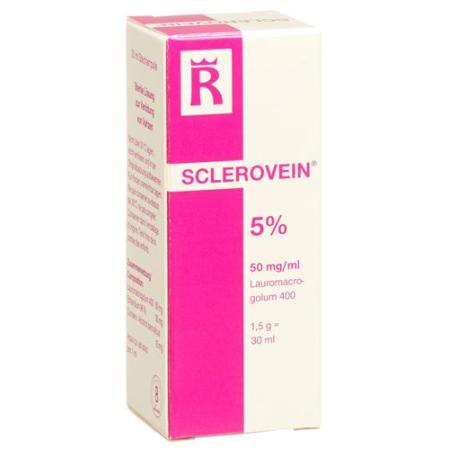
Sclerovein Inj Loes 5% i.v. flow 30 ml
Sclerovein Injektionslösung i.v. 5% Durchstechflasche 30 ml
Send a request to get a price
Not availableDescription - Sclerovein Inj Loes 5% i.v. flow 30 ml
composition
Active ingredient: Lauromacrogol 400 (Polidocanolum 600).Auxiliary materials: Ethanolum 96% 50 mg / 1 ml corresp .: Ethanolum absolutum 48 mg / 1 ml, conserv .: Alcohol benzylicus, aqua qs ad solutionem.
Galenic form and amount of active ingredient per unitSclerovein 0.5%
Ampoule with 30 ml solution for injection contains 150 mg lauromacrogol 400.
Sclerovein 1%
Ampoule with 30 ml solution for injection contains 300 mg lauromacrogol 400.
Sclerovein 2%
Ampoule with 30 ml solution for injection contains 600 mg lauromacrogol 400.
Sclerovein 3%
Ampoule with 30 ml solution for injection contains 900 mg lauromacrogol 400.
Sclerovein 5%
Ampoule with 30 ml solution for injection contains 1500 mg lauromacrogol 400.
Indications / possible uses
Sclerotherapy of varices (branch varicose; perforant varicose; outpatient, operative treatment of trunk varicose veins combined with sclerotherapy), venectasia (spider veins), hemorrhoids, anal fissures and hemangiomas.
Dosage / applicationNotes on dosage
Sclerovein is to be injected strictly intravenously (variceal obliteration) or strictly submucosal (hemorrhoid obliteration).In general, the dose of 2 mg / kg body weight and day should not be exceeded.An extensive varicosis should always be treated in several sessions.In patients prone to hypersensitivity reactions, no more than 1 injection should be given during the first treatment. Depending on the outcome of the treatment and the extent of the area to be sclerosed, several injections can be given for subsequent treatments, observing the maximum dose (2 mg / kg and day).
Variceal obliteration
The amount of dosage and the concentration of the solution result from the thickness of the variceal cord. The smallest varices are treated with the 0.5?1.0% solution, medium-sized with the 1.0?2.0%, and the largest with the 3.0?5.0% solution. One starts with a weaker solution and injects 0.2?0.5 ml. If the desired sclerosing effect does not occur, the concentration is increased rather than the dose. In the case of very large varices, up to 2 ml can be injected.The obliteration is carried out with the leg in a horizontal position or with the leg raised 30?45 ° above the horizontal position. The puncture can be made with the patient standing if the leg is then brought into a horizontal position. If desired, the air-block technique can also be used or sclerovein can be injected as a foam. The obliteration of medium-sized and large varices should, however, be carried out strictly intravenously and without air. The injection should not be given too slowly to avoid excessive dilution. After applying Sclerovein, compress the puncture site tightly with a gauze swab and then apply a tight, elastic compression bandage. The bandage should be worn for approx. 6?8 weeks and may only be removed when the leg is raised. While getting up,Patients should be encouraged to exercise extensively. Bed rest is contraindicated.The number of repeat treatments (at intervals of 1?2 weeks) depends on the extent of the varicose vein.
Spider veins
These stained local venectasias are best obliterated with 0.5% Sclerovein solution. The procedure is the same as for variceal obliteration. Depending on the size of the area to be sclerosed, inject 0.1?0.2 ml of sclerovein 0.5% intravascularly, if the central veins are sclerosed, 0.1?0.2 mg of sclerovein 1%. If the injection into the central vein is unsuccessful, Sclerovein 0.5% should be administered extravasally.The patient should walk for at least 30 minutes immediately after treatment. Subsequent hard local compression for at least 2-3 days is necessary for the treatment to be successful.
Hemangiomas
These are suitable for a corresponding procedure, but it is not always possible to obliterate the entire angioma in one session.
hemorrhoids
Sclerotherapy is used for internal hemorrhoids in stage 1 (success rate 90%) and in stage 2 (success rate 25%). Targeted preparations (such as enemas) are not necessary or rather annoying.Blanchard's method: In the case of internal hemorrhoids, sclerovein is injected submucosally orally towards the hemorrhoidal node into the inflow areas of the hemorrhoidal convolute at 3, 7 and 11 o'clock. According to the ADR heading, pain is possible during the injection.Blond method: Using a Roschke drip syringe, sclerovein is injected drop by drop through the side protoscope window directly into the protruding hemorrhoidal nodule. The patient receives up to 10 injections per session.
dosage
Inject 0.5?1.5 ml of Sclerovein 3% or 5% strictly submucosally per node. Exception of the 11 o'clock knot in men: inject a maximum of 0.5 ml.In the first treatment, administer a maximum of 2 ml in total, in the following sessions (interval 1?2 weeks) a maximum of 3 ml Sclerovein 3% or 2 ml Sclerovein 5%.In the case of external hemorrhoids, the stalk should be injected drop by drop, strictly subcutaneously, into the stalk. Under no circumstances should it be injected into the inside of the node, as this could sclerose deeper blood vessels.Note: The aim of the treatment is not (as in the case of obliteration of varices) to induce an intimate reaction, but to create a fibrosis that restricts the arterial flow.Usually 4?8 sessions are planned at monthly intervals, injection intervals of several weeks are required. The anamnesis is specifically taken at each session; residual infiltrates are excluded by rectal palpation.
Anal fissures
Anal fissures can be healed by sclerotherapy with sclerovein.
Hints
Variceal obliteration: strictly intravenous injection, if possible also with spider vein varices.Hemorrhoid obliteration: strictly submucosal injection above the nodule.Like all sclerosing agents, sclerovein must never be injected intra-arterially, as this can lead to severe necrosis, which can force an amputation. In the event of such an incident, a vascular surgeon must be called in immediately (see «Warnings and precautionary measures»).The use and safety of Sclerovein in children and adolescents has not yet been tested.
Contraindications
Intra-arterial application is strictly contraindicated because of the risk of severe damage (especially gangrene of the relevant extremity). Further contraindications are: known intolerance to the sclerosing agent, condition after recent thrombosis, damage to the deep veins, arterial occlusive disease grade III and IV, bed-ridden patient, concurrent infections, 1st trimester of pregnancy, diabetes mellitus, acute severe heart diseases, all diseases and Situations associated with restricted freedom of movement. Acute inflammation in the anal area is contraindicated in the case of hemorrhoid obliteration.The use of Sclerovein is not intended in children and adolescents.
Warnings and Precautions
In addition to the information listed under ?Dosage / Application?, the following precautionary measures must be observed: because the shock reaction cannot be ruled out, the medication for countermeasures should generally be available in the event of sclerotherapy.The most common, serious complication is paravenous injection, followed by intra-arterial application:Paravenous application can lead to skin necrosis, which heals poorly and can lead to pigment changes and loss of sensitivity. Attention should be paid to the possible involvement of an adjacent artery. The necrosis should be excised as soon as possible.The erroneous intra-arterial injection usually leads to peripheral paresis and extensive necrosis, in some cases even to loss of the extremity. Therefore, the following measures must be taken after intra-arterial injection: Inject 5?10 ml of 1?2% lidoc. or mepivacaine and heparin 500 IU through the same cannula. Wrap the ischemic leg in cotton wool, lay it down and hospitalize the patient as a precaution (vascular surgery).In the case of nephropathies, in particular glomerulonephritis and nephrosis, hepatopathies, acute and chronic diseases of the cardiovascular system, febrile conditions, arterial occlusive disease grade II, old age or poor general condition, bronchial asthma and hemorrhoids: acute inflammation in the anal area must be strictly indicated.For all sclerosing agents there is a strict indication in the facial area, since an intravascular injection can lead to a pressure reversal in the arteries and thus to an irreversible eye disorder (blindness).In the case of sclerosing in the ankle area, only a small amount in low concentration should be administered in order to avoid excessive sclerosing reactions. The risk of accidental intra-arterial injection in the ankle area should also be considered.Discoloration of the skin due to hemosiderin after sclerotherapy at the site of the previous varicose vein cannot be completely prevented by precise stab incision and removal of the thrombus, but it can be reduced. The compression bandages should therefore be worn for 6?8 weeks and exposure to the sun should be avoided. The discoloration almost completely disappears in a year.
Interactions
Since Lauromacrogol 400 is also a local anesthetic, there is a risk of increasing their antiarrhythmic effects when administered simultaneously with anesthetics. Therefore, after surgical removal of the trunk varices, the lateral branch varices should only be sclerosed at intervals of 1?2 days.
Pregnancy / lactation
Controlled studies in animals or pregnant women are not available for sclerovein. In these circumstances, the drug should only be administered if the potential benefit outweighs the fetal risk. However, sclerotherapy should not be performed in the first trimester of pregnancy and after the 36th week of pregnancy.Sclerovein should not be used in breastfeeding women.
Effects on ability to drive and use machines
No relevant studies were undertaken. Due to the possible adverse effects, Sclerovein can have an influence on the ability to drive or use machines.
unwanted effectsFrequency information
Very common: ?10%, common: ?1% to
Sclerotherapy of varices
The injection of Sclerovein can cause the following reactions due to the pharmacological properties or the type of application:
blood
Common: Local (at the application site) intravaricous blood clots.
immune system
Very rare: systemic allergic reactions (such as anaphylactic shock, Quincke's edema or asthmatic symptoms).
Nervous system
Common: sensation of pain during injection.Very rare: headache, migraine, local sensory disturbances, taste sensations (metallic or furry taste).
eyes
Very rare: visual disturbances.
Cardiovascular
Very rare: vasovagal reactions (collapse, loss of consciousness, confusion, dizziness), palpitations, changes in blood pressure.
Vascular diseases
Common: appearance of vessels in the sclerotherapy area that could not be seen prior to treatment (matting, neovascularization).Uncommon: Superficial phlebitis (periphlebitis, thrombophlebitis).Rare: deep vein thrombosis of unknown cause, possibly due to the underlying disease.Very rare: vasculitis.
Respiratory system
Very rare: difficulty breathing and pressure in the chest, pulmonary embolism.
Gastrointestinal disorders
Very rare: nausea.
Skin and skin appendages
Common: discoloration of the skin (hyperpigmentation, less often hematomas and ecchymosis) at the application site.Uncommon: Local (at the application site) tissue destruction (necrosis), especially of the skin and the underlying tissue (rarely from nerves) after accidental injection into the surrounding tissue (extravascular injection), whereby the risk increases with increasing sclerovein concentration and amount elevated.Local (at the application site) allergic and non-allergic skin reactions (e.g. reddening, urticaria, swelling, induration).Very rare: hypertrichosis in the area of ??sclerotherapy.
Generalized disorders
Feeling hot, fever.
Sclerotherapy of hemorrhoids
The injection of Sclerovein can cause the following reactions due to the pharmacological properties or the type of application:
immune system
Very rare: systemic allergic reactions (such as anaphylactic shock or Quincke's edema).
Nervous system
Rare: pain, especially in men with sclerotherapy in the area of ??the 11 o'clock node (prostate area). This pain can last for 2-3 days.Very rare: dizziness.
Cardiovascular
Very rare: cardiovascular reactions (e.g. lowering blood pressure).
Vascular diseases
Rare: bleeding (at the application site).
Gastrointestinal disorders
Very rare: nausea.
Skin and skin appendages
Uncommon: Allergic and non-allergic skin or mucous membrane reactions (e.g. urticaria, induration, itching).Rare: necrosis (locally at the application site, rarely with expansion into surrounding tissue).
Reproductive system
Very rare: erectile dysfunction.
Overdose
An overdose caused by too high a dose or concentration can cause local necrosis, especially with paravenous application. Depending on the amount and concentration of the injected sclerovein, procaine 1% (0.5?2 ml) or physiological saline (5?20 ml), if possible together with hyaluronidase, are injected at the same place.
Properties / effects
ATC code: C05BB02
Mechanism of action
Lauromacrogol 400 has a sclerosing and at the same time local anesthetic effect. This enables an almost painless sclerotherapy treatment. The effect is aimed primarily at the venous intima. With the greatest affinity for the damaged intima, there is no effect if the vascular lining is intact, so that sclerotherapy can only be successful if the vein has actually changed varicose veins, but not if the vein is simply cylindrically moderately enlarged. This sclerosing effect is based on the irritation of the venous intima, which creates a local, firmly adhering thrombosis in the area of ??the damaged endothelium. The compression bandage to be applied after the treatment compresses the vein walls and prevents the recanalization of the organizing thrombus,With paravascular application of Lauromacrogol 400, the local edema formation leads to compression of the varices and cicatricial hardening.With the correct choice of concentration and dosage as well as the correct treatment technique and aftercare (compression treatment), Sclerovein is well tolerated and causes reliable and sustainable sclerotherapy.
Pharmacokinetics
No pharmacokinetic studies have been performed with sclerovein. The following data were taken from the literature.
Lauromacrogol 400
Approx. 90% of the Lauromacrogol 400 administered is eliminated from the blood just 12 hours after intravenous administration. Even after repeated administration of lauromacrogol 400 in the time intervals customary for sclerotherapy, accumulation can be ruled out. In a study, the following values ??were found after a single intravenous administration: protein binding 64%, terminal elimination half-life 4 hours, volume of distribution 24.5 l, total clearance 11.7 l / h, renal clearance 2.43 l / h and biliary clearance 3.14 l / h.
Ethanol
No data are available on the rate of absorption of ethanol.
distribution
The volume of distribution of ethanol is 0.68 l / kg in men and up to 0.55 l / kg in women, and it is reached very quickly.Ethanol gets into both fetuses and breast milk.
metabolism
Ethyl alcohol is oxidized to acetaldehyde by alcohol dehydrogenase in the liver, while acetaldehyde is broken down into acetic acid by acetaldehyde dehydrogenase. This metabolic breakdown pathway accounts for 90?96% in humans.
elimination
The rate of elimination is independent of the concentration and is 0.1 g / kg / h in men and 0.085 g / kg / h in women (hourly degradation approx. 0.15 ?). Only insignificant proportions are eliminated via the lungs (2?3%) and kidneys (1?2%).
Preclinical dataacute toxicity
The acute toxicity of Lauromacrogol 400 has been tested on several species (see table). According to the LD 50 values, lauromacrogol 400 was the most toxic in rabbits, followed by guinea pigs, mice and rats.
| speciesIntravenous administration (mg / kg)Oral administration (mg / kg)Subcutaneous administration (mg / kg) |
| mouse85-1361170-3300620-3800rat63-3904150954-1310Guinea pig38384-Rabbits11-36-- |
The toxic doses after lethal and sublethal doses of lauromacrogol 400 were comparable between the species and between the routes of administration, albeit with differences with regard to the time to onset and the intensity of the symptoms. Symptoms appeared most rapidly and severely after intravenous administration, followed by subcutaneous and oral administration.All routes of application of Lauromacrogol 400 resulted in dose-dependent local toxicity. Acanthosis, necrosis of the venous wall (the intended pharmacological effect), scab formation, abscess formation, fibrosis of the skin and the formation of granulation tissue were found at the puncture sites.Application in the range of the maximum human dose: No signs of acute systemic toxicity were seen in rats and rabbits given 4 mg lauromacrogol 400 per kg body weight (twice the maximum dose for treating varicose veins in humans) subcutaneously. Rabbits given intravenously 2 mg lauromacrogol 400 per kg body weight (the maximum dose for treating varicose veins in humans) also showed no signs of acute systemic toxicity. Even rats showed no signs of intoxication after administration of 2 mg / kg lauromacrogol 400.
Chronic toxicity
The multiple application of Lauromacrogol 400 was investigated in mice, rats, guinea pigs, rabbits and dogs with different types of application. Signs of systemic toxicity occurred dose-dependently after multiple doses of Lauromacrogol 400, but the symptoms disappeared after the end of the application. Almost all animals showed dose-dependent symptoms at the injection site (swelling, induration, necrosis, histologically: connective tissue induration, formation of granulation tissue, formation of vascular collateral and perivascular swellings).Repeated administration of lauromacrogol 400 in higher doses (3 mg / kg and higher) resulted in dose-dependent sleepiness, increased salivation and reduced body weight in rats, rabbits and dogs. In addition, respiratory depression, dyspnoea, fatigue and ataxia were observed in rats. Male rats treated with 4 mg lauromacrogol 400 per kilogram body weight and day or more showed a dose-dependent increase in liver weight. The repeated administration of 8 mg / kg lauromacrogol 400 led to convulsions in rabbits. In dogs vomiting, faeces, bradycardia, ataxia and tremor occurred immediately after injection of 16 mg / kg lauromacrogol 400. In most cases, symptoms disappeared after the intake was stopped.
Pharmacodynamic studies
When examined in guinea pigs, temporary bradycardia occurred in the dose range of 20?25 mg / kg iv and an atrial ventricular block from 30 mg / kg. In rats, a decrease in the force of contraction of the heart and end-diastolic aortic pressure was found intracardially from 25 mg / kg. In the anesthetized rat, intravenous administration of 10-40 mg / kg caused a drop in blood pressure, a reduction in heart rate and an increase in the PQ time. A continuous infusion of 1 mg / kg / min lauromacrogol 400 showed negative inotropic and chronotropic effects in rabbits after 5 minutes.
Teratogenicity, mutagenicity and carcinogenicity
Studies on teratogenicity, mutagenicity, genotoxicity and carcinogenicity did not reveal any evidence of teratogenic effects or a mutagenic / carcinogenic potential of the substance.
Other notesIncompatibilities
In the absence of compatibility studies, this medicinal product must not be mixed with other medicinal products.
durability
The drug may only be used up to the date marked ?EXP? on the pack.
Special storage instructions
Do not store above 30 ° C and in the original packaging. Do not freeze.
Storage instructions after opening
Store in the refrigerator after opening and use within 24 hours.
Approval number
36907 (Swissmedic).
Marketing authorization holder
Resinag AG, Zug.