

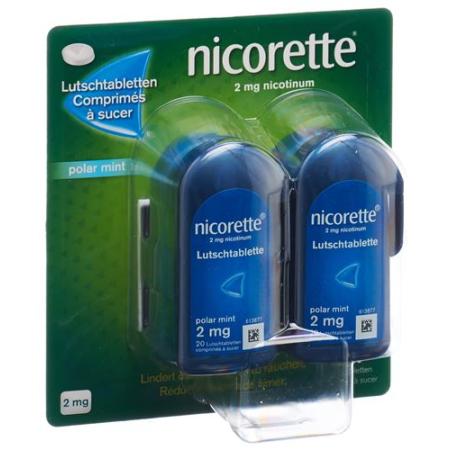
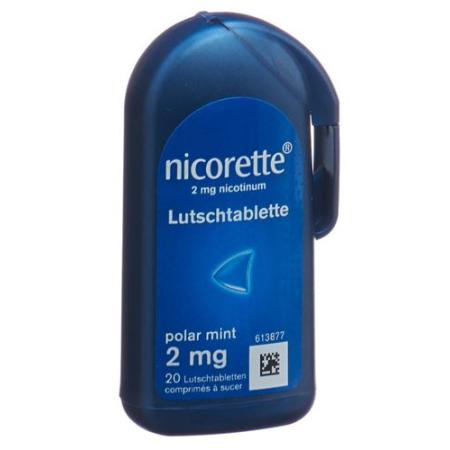
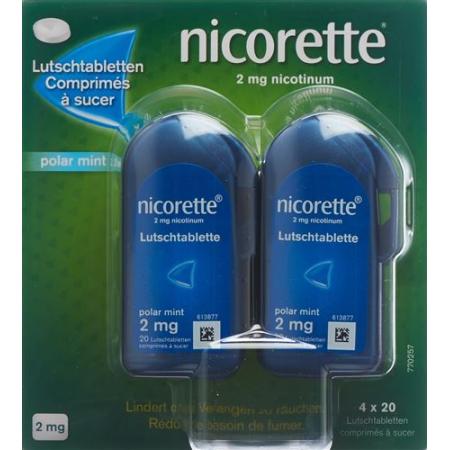
Nicorette Polar Mint lozenges 2 mg 80 pcs
NICORETTE POLAR MINT 2MG
Send a request to get a price
Not availableDescription - Nicorette Polar Mint lozenges 2 mg 80 pcs
What are Nicorette lozenges and when are they used?
Nicorette lozenges are lozenges containing nicotine. They are recommended as a support if you want to quit smoking or reduce cigarette consumption as a first step.When using the lozenges, nicotine is released for about 20 minutes. Nicotine is the addictive component in tobacco smoke and is responsible for the various withdrawal symptoms associated with smoking cessation. By administering nicotine with Nicorette lozenges, these withdrawal symptoms are reduced and it is easier for smokers to give up cigarettes. This roughly doubles the chances of successfully quitting smoking.After a while, experience has shown that after you have developed new habits (substitute actions for smoking), you will find it easier to gradually get by with fewer Nicorette lozenges and later to forgo it altogether. Health damage caused by the tar and carbon monoxide content in tobacco smoke is avoided.
What should be considered?
Your motivation and willpower are decisive for the success of the treatment.If you use Nicorette lozenges to reduce cigarette consumption, there is probably no risk of higher nicotine levels than with regular smoking if Nicorette lozenges are only used during the smoke-free intervals.
If you use Nicorette 2 mg If you use lozenges as part of a cessation treatment or in combination with the Nicorette Invisi depot patch, you should stop smoking completely, as continuing to smoke carries the risk of side effects, including for the heart and circulation, and the risk of maintaining nicotine dependence due to higher nicotine levels than habitual smoking.It is therefore important that you are strongly motivated to quit smoking before starting Nicorette treatment. Professional smoking advice increases the chances of successfully quitting.
Nicorette lozenges are sweetened with mannitol, sucralose and acesulfame potassium, which is why diabetics can also use Nicorette lozenges (see «What does Nicorette lozenges contain?»).
When should Nicorette lozenges not be used?
Nicorette lozenges should not be used by non-smokers and children under the age of 12! For young people under 18 and over 12 years of age, the drug should only be used if they are heavily dependent on nicotine and only after consultation with a doctor, pharmacist or druggist. Nicorette lozenges should not be used if there is a known hypersensitivity to nicotine or other ingredients in the lozenges.
When is caution required when using Nicorette lozenges?
If you suffer from health disorders, chronic Throat disorders, or any of the following disorders, you should carefully discuss the benefits and risks with your doctor before starting the Nicorette treatment program:Kidney and liver disease, inflammation of the esophagus or Stomach and intestinal ulcers, overactive thyroid gland, pheochromocytoma (adrenaline-producing tumor of the adrenal gland), diabetes.Heart disorders: addicted smokers immediately (less than 4 weeks) after a heart attack, with unstable or worsening angina pectoris, severe cardiac arrhythmias, uncontrolled high blood pressure or recent stroke should only use Nicorette lozenges under medical supervision. The use of the preparation should only be considered in these cases if smoking cessation is supported without medicationtion is not possible. If new cardiovascular symptoms develop or if existing cardiovascular symptoms worsen (chest pain, irregular pulse, shortness of breath), consult a doctor.This medicine may affect your ability to react, drive and use tools or tools to operate machines.Inform your doctor, pharmacist or druggist if you
- on suffer from other diseases,have allergies ortake other medicines (including those you bought yourself!).
The warnings and precautionary measures that apply to The individual preparations apply also apply to the combination treatment of depot patches and lozenges.
Smoking cessation with or without Nicorette lozenges can affect the reaction to concomitantly administered drugs for asthma, cardiac arrhythmias, severe pain, mood disorders, Alzheimer's disease, Parkinson's, change restless leg syndrome or diabetes (insulin). If necessary, your doctor will prescribe a dose adjustment of the medicines concerned.
Can Nicorette lozenges be used during pregnancy or while breastfeeding?
Smoking cessation is the most effective single measure for stopping smoking Improving the health of the pregnant smoker and the baby. The sooner you stop smoking, the better.Nicotine should not be used in any form during pregnancy. Nicotine, and especially smoking, can seriously endanger the health of the fetus and child and should be discontinued during pregnancy. Pregnant women who smoke should only use Nicorette after consultation with their doctor, pharmacist or druggist.Nicotine should not be taken/used while breastfeeding. If smoking cessation is not achieved, Nicorette lozenges should only be used in breast-feeding smokers after consulting a doctor, pharmacist or druggist. Should the use of Nicorette lozenges be necessary, Nicorette lozenges should be used immediately after breastfeeding and allow as much time as possible before the next breastfeeding (at least 2 hours).
How do you use Nicorette lozenges? h3>
Nicorette lozenges are intended for adults aged 18 and over. For young people under the age of 18 and over 12, the preparation should only be used if there is a strong nicotine dependency and only after consultation with the doctor, pharmacist or druggist.
The starting dose should be determined individually based on the nicotine dependency. 8-12 Nicorette lozenges per day should usually be sufficient.No more than 15 lozenges per day should be used.
Handling the container
p>
Application
This medicinal product is intended for use in the oral cavity. It is placed in the mouth, where it dissolves and releases nicotine to be absorbed by the body through the lining of the mouth.Always use the medicine as follows: Put a lozenge in your mouth and slide it out Swipe it from side to side of your mouth from time to time until completely dissolved. This generally takes less than 20 minutes. Do not chew the lozenge or swallow it whole. If you have a lozenge in your mouth, you should not eat or drink.
Quiting
Most smokers need 8-12 lozenges per day. Up to 15 Nicorette lozenges can be used as needed. NAfter 8 weeks, it's time to start gradually cutting back on nicotine. For the next 2 weeks, reduce the number of lozenges per day by half. Stop treatment after the next 2 weeks if you managed to get the dose down to 0 on the last day. The duration of treatment is individual, but is a maximum of 3 months.
Combination with Nicorette Invisi depot patch (15 mg or 10 mg)
For strong or uncontrollable cravings for smoking or for people who are undergoing therapy If you have relapsed with a single nicotine preparation, it may be useful to use Nicorette 2 mg lozenges in addition to Nicorette Invisi depot patches.
People with severe cardiovascular disease or a stroke that was less than 4 weeks ago , heart attack, angina pectoris, cardiac arrhythmia, coronary artery surgery (e.g. bypass) or uncontrolled high blood pressure may only use the combination therapy after consulting a doctor.
The depot patch is applied daily for 16 hours according to the package insert carried. If there is a craving for cigarettes or if withdrawal symptoms are felt, an additional Nicorette 2 mg lozenge can be used (maximum 15 per day). The Nicorette Invisi depot patch at 15 mg/16 hours is used for the first 8 weeks, then the depot patch at 10 mg/16 hours for 4 weeks. The combination of depot patch and lozenges at 2 mg may be used for a maximum of 3 months. The 2 mg lozenges can then be used alone for up to a total of 12 months (slowly reduce the number of lozenges per day to 0).
Reduction in cigarette consumption
The lozenges are used during the smoking-free intervals are used to extend them as long as possible and thus reduce cigarette consumption as much as possible. Never use the lozenges and smoke at the same time or use the lozenges and smoke in direct succession without a break. If you have not achieved a significant reduction in daily cigarette consumption after 6 weeks, you should seek advice from your doctor.You should try to quit smoking as soon as you feel ready, but no later than 6 months after starting treatment. If you are still unable to stop smoking 9 months after starting treatment, you should consult your doctor.The recommended duration of treatment with Nicorette lozenges is a maximum of 12 months. Unused lozenges should be kept as the urge to smoke may suddenly return.Stick to the dose given in the package leaflet or as prescribed by your doctor. If you think the medicine is too weak or too strong, talk to your doctor, pharmacist or druggist.
What side effects can Nicorette lozenges have?
Nicorette lozenges can cause the same undesirable effects as other forms of nicotine. These are generally dose dependent.Some of the undesirable effects of quitting smoking may be withdrawal symptoms due to reduced nicotine intake. These include irritability, aggression, impatience, frustration, anxiety, restlessness, difficulty concentrating, waking up late at night, trouble sleeping, increased appetite, weight gain, constipation, feeling depressed, craving to smoke, slow heart rate, bleeding gums, dizziness, lightheadedness, cough, sore throat, mouth ulcers, stuffy or runny nose. If you stop smoking, canker sores can also develop. The reason for this is unknown.Most side effects occur during the first few weeks afterch start of Nicorette treatment.The undesirable reactions in a combination treatment of depot plaster and lozenges do not differ significantly from those of monotherapy with one of the two preparations. The frequency of occurrence corresponds to that reported for each individual preparation.
Very common (affects more than 1 user in 10)
Headache, gastrointestinal disorders, hiccups , nausea, sores in the mouth and throat, cough, irritation in the throat.
Common (affects 1 to 10 users in 100)
Hypersensitivity reactions, sensory disturbances, taste disturbances, vomiting, indigestion, intestinal gases , abdominal pain, dry mouth, increased salivation, inflammation of the lining of the mouth, diarrhoea, burning sensation in the mouth/lips, tiredness.
Uncommon (affects 1 to 10 users in 1000)
Abnormal dreams palpitations, tachycardia, flushing, high blood pressure, difficulty breathing, voice changes, sneezing, stuffy/runny nose, pain in the mouth, tightness in the throat, belching, inflammation of the tongue, scaling of the oral mucosa, increased sweating and itching, skin rash, reddening of the skin, hives , mouth discomfort, weakness, discomfort, pain and discomfort in the chest.
Rare (affects 1 to 10 users in 10,000)
Decreased sensitivity in the mouth, difficulty swallowing, Nausea.Allergic reactions, blurred vision, increased lacrimation, dry throat, lip pain and swelling of the face/throat have also been reported.Persistent nicotine dependence may occur.
Overdose can occur when nicotine replacement products are not used as recommended, for example when multiple lozenges are mistakenly used at the same time or in rapid succession, or when smoking occurs at the same time. In the event of an overdose, the symptoms correspond to those of acute nicotine poisoning. The following occur: nausea, vomiting, salivation, abdominal pain, diarrhea, sweating, headache, dizziness, hearing disorders and pronounced weakness. In extreme cases, the following can follow: drop in blood pressure, weak, irregular pulse, shortness of breath, fainting, circulatory collapse and generalized seizures. In this case, the nicotine supply must be stopped immediately.
If you suspect nicotine poisoning in a child, or if a child has taken Nicorette Lozenges, or if you have used more Nicorette Lozenges than recommended, contact your doctor or nurse immediately doctor or go to the nearest hospital. Doses that are well tolerated by adult smokers can cause severe and possibly life-threatening symptoms of poisoning in children.If you notice any side effects, contact your doctor, pharmacist or druggist. This also applies in particular to side effects that are not listed in this leaflet.
What else should you be aware of?
Nicotine is a highly effective substance. Even at a dosage that is tolerable for adults during treatment with Nicorette lozenges, nicotine can lead to life-threatening symptoms of poisoning in children. Nicorette lozenges must therefore be kept out of the reach of children and disposed of at all times.
Shelf life
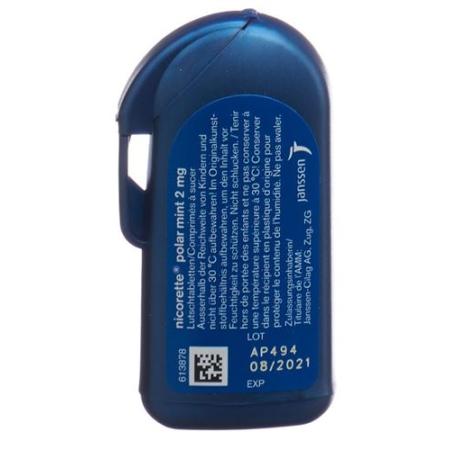
The medicinal product may only be used up to the date marked «EXP» on the container. The expiry date refers to the last day of that month.
Storage instructions
Keep below 30°C and out of the reach of children.Store in the original plastic container in order to the contents from moistureto protect them.
Further information
Do not use the container for any other purpose as it may contain tablet dust which may form a fine coating on the items inside the container.Dispose of the container responsibly. Medicines should not be disposed of via wastewater or household waste. Ask your pharmacist how to throw away medicines you no longer use. This measure helps to protect the environment.Your doctor, pharmacist or druggist can provide you with further information. These people have the detailed technical information.
What does Nicorette lozenges contain?
Nicorette lozenges contain nicotine.
Active ingredients
Nicotine (as nicotine resinate)
1 Nicorette lozenge contains 2 mg nicotine (as nicotine resinate).
Excipients
Tablet core: 551 mg mannitol (= 1.3 kcal ), Xanthan Gum, Flavouring: Winterfresh RDE4-149 Spray Dried (Gum Arabic, Peppermint, Menthol and Eucalyptol Flavouring), Anhydrous Sodium Carbonate, Sucralose, Acesulfame Potassium, Magnesium Stearate.Coating: Hypromellose, Flavouring: Winterfresh RDE4-149 (peppermint, menthol and eucalyptol flavor), titanium dioxide, sucralose, Sepifilm Gloss (hypromellose, microcrystalline cellulose, potassium aluminum silicate, titanium dioxide), acesulfame potassium, polysorbate 80.
Registration number h3>
66204 (Swissmedic).
Where can you get Nicorette lozenges? What packs are available?
In pharmacies and drugstores, without a doctor's prescription.
Pack sizes
Each container contains 20 lozenges. The packs contain one or four containers of 20 lozenges each (corresponding to 20 or 80 lozenges).
Authorization holder
Janssen-Cilag AG, Zug, ZG.This leaflet was last checked by the drug authority (Swissmedic) in October 2019.