

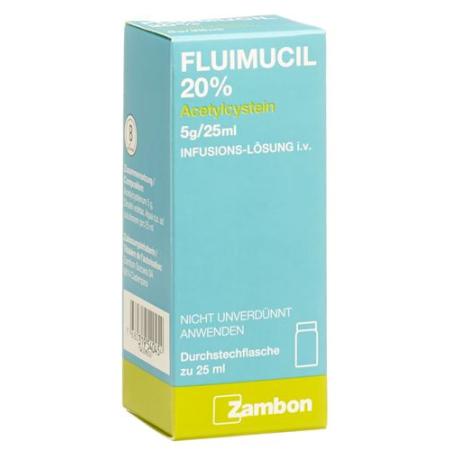
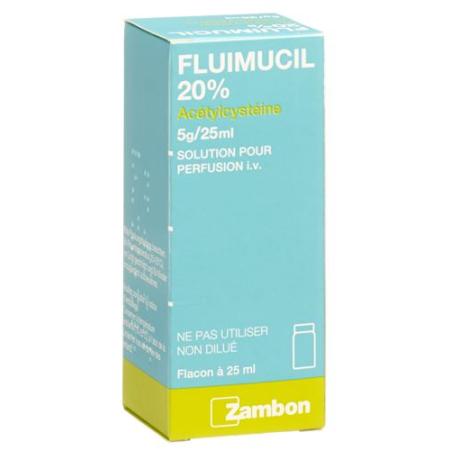
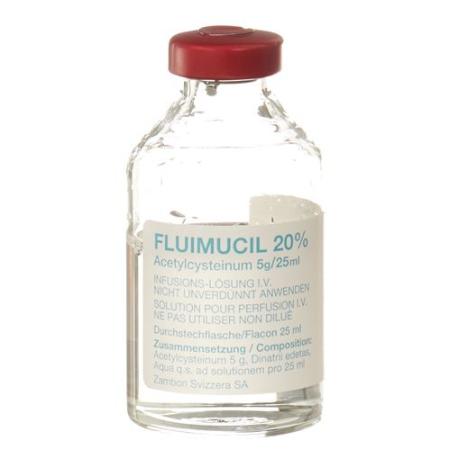
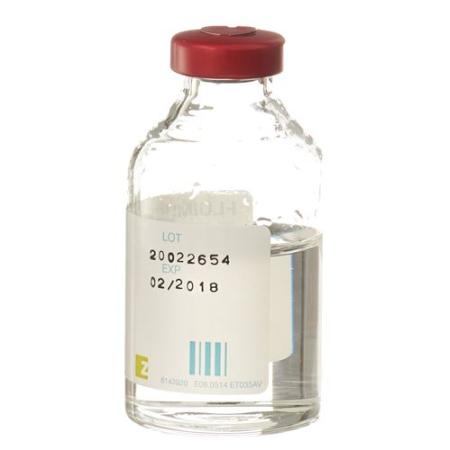
Fluimucil 20% Inf Los 5 mg/25 ml perf 25 ml
Fluimucil 20% Infusionslösung 5g/25ml Durchstechflasche 25ml
Send a request to get a price
In stock 50 pcsDescription - Fluimucil 20% Inf Los 5 mg/25 ml perf 25 ml
Composition
Active ingredients
Acetylcysteinum.
Auxiliary materials
Dinatrii edetas, Natrii hydroxidum, Aqua ad iniectabilia.
Dosage form and amount of active ingredient per unit
Infusion solution for iv use.Vial: 5 g acetylcysteine ??per 25 ml (200 mg / ml).
Indications / possible uses
Antidote for acute acetaminophen poisoning.Acute liver failure after acetaminophen poisoning.
Dosage / applicationAntidote for acute acetaminophen poisoningIntravenous dosage regimen according to Prescott
Complete treatment with acetylcysteine ??involves 3 consecutive intravenous infusions. The doses should be given one after the other with no breaks in between.Total dose: 300 mg / kg acetylcysteine ??(corresponding to approx. 5 vials of Fluimucil 20% for a body weight of 70 kg); Total duration 21 hours.
The following treatment regimen is recommended:
- Weigh the patient to determine the correct weight interval.Use the dosage table to determine the appropriate volume of acetylcysteine ??(vial volume) to add to the infusion solution for each of the 3 infusion periods.1 vial of Fluimucil 20% contains 25 ml: 5 ml = 1 g acetylcysteine. Glucose 5% or NaCl 0.9% can be used as infusion solution.
First infusion
Initial bolus 150 mg / kg in glucose 5% or NaCl 0.9% over 60 minutes.A faster initial bolus of 15-60 minutes can also be given, but the slow bolus (over 60 minutes) reduces the likelihood of anaphylactoid reactions.
Second infusion
50 mg / kg in glucose 5% or NaCl 0.9% over 4 hours (= 12.5 mg / kg / h).
Third infusion
100 mg / kg in glucose 5% or NaCl 0.9% over 16 hours (= 6.25 mg / kg / h).When calculating the dosage for obese patients, an upper limit weight of 110 kg should be used.The dosage should be calculated based on the patient's actual weight.
Dosage tablePrescott Scheme (for children and adults)
weight1st phase |
Per 1 kg0.75 ml3 ml0.25 ml7 ml0.5 ml14 ml10 kg7.5 ml30 ml2.5 ml70 ml5 ml140 ml15 kg11.25 ml45 ml3.75 ml105 ml7.5 ml210 ml20 kg15 ml60 ml5 ml140 ml10 ml280 ml25 kg18.75 ml100 ml6.25 ml250 ml12.5 ml500 ml30 kg22.5 ml100 ml7.5 ml250 ml15 ml500 ml40 kg30 ml150 ml10 ml300 ml20 ml600 ml50 kg37.5 ml150 ml12.5 ml300 ml25 ml600 ml60 kg45 ml200 ml15 ml400 ml30 ml800 ml70 kg52.25 ml250 ml17.5 ml500 ml35 ml1000 ml80 kg60 ml250 ml20 ml500 ml40 ml1000 ml90 kg67.5 ml250 ml22.5 ml500 ml45 ml1000 ml100 kg75 ml250 ml25 ml500 ml50 ml1000 ml?110 kg82.25 ml250 ml27.5 ml500 ml55 ml1000 ml |
Acute liver failure after acetaminophen poisoning
Even in the case of acute liver failure after paracetamol poisoning, the Prescott treatment regimen is recommended for the first 21 hours. Thereafter, the last given infusion rate of 150 mg / kg / 24 hours should be continued until the encephalopathy disappears.
Special dosage instructionsChildren / patients weighing less than 40 kg
Children should be treated with the same doses as adults. However, the amount of intravenous solution must be adjusted to take account of age and weight as fluid overload is a potential hazard.Further dilutions should be made according to the individual fluid balance of the child, taking into account all other fluid intake.The doses should be administered sequentially using a suitable intravenous infusion pump.
Contraindications
In the case of threatening paracetamol poisoning, antidote treatment with acetylcysteine ??can also be carried out in the case of anamnestic hypersensitivity or small children with appropriate monitoring / accompanying measures.
Warnings and Precautions
Intravenous administration of acetylcysteine ??must be carried out under strict medical supervision. Adverse effects of acetylcysteine ??therapy are more likely to occur if administration is too rapid or in excess. It is therefore recommended to strictly follow the dosage instructions.
Anaphylactic / anaphylactoid reactions
Anaphylactic / anaphylactoid reactions occur with acetylcysteine, especially with the starting dose. The patient should be carefully monitored for signs of an anaphylactoid reaction during this time. Asthma and hypervolaemia (fluid overload) are risk factors for developing these undesirable effects. Fatal cases of intravenous acetylcysteine ??as an antidote in acetaminophen poisoning associated with anaphylactic / anaphylactoid reactions have been reported very rarely.These reactions to acetylcysteine ??usually occur 15 to 60 minutes after the start of the infusion. In many cases of anaphylactoid reactions, temporarily stopping the infusion and taking antihistamines provide sufficient relief. In the case of higher-grade system reactions, however, inhaled bronchodilators, adrenaline and corticosteroids may also be necessary.If antihistamines are used to control a reaction, the infusion can be resumed under close supervision at an infusion rate of 50 mg / kg over 4 hours, followed by the last 16-hour infusion (100 mg / kg) if tolerated. kg over 16 hours).No therapeutic measures are required for flush.In urticaria, administration of antihistamines and occasionally corticosteroids is recommended; acetylcyst administration can be continued.In the case of angioedema and respiratory symptoms, slowing down the acetylcyst intake, possibly a temporary interruption, is recommended. An antihistamine, occasionally corticosteroids and possibly a bronchodilator and / or adrenaline may be required.
Bronchial asthma
There is evidence that patients with a history of atopy and asthma are at increased risk of developing an anaphylactoid reaction. Patients with bronchial asthma should be closely monitored during therapy. Should bronchospasm occur, acetylcysteine ??must be discontinued and adequate therapeutic measures must be taken.
Body fluid and electrolytes
In patients with a body weight of less than 40 kg, due to the possible risk of hypervolemia (fluid overload) with the following hyponatremia, seizures and death, the antidote doses should be administered carefully. It is therefore recommended to strictly follow the dosage instructions.
Coagulation
Administration of acetylcysteine ??can prolong prothrombin time in addition to acetaminophen toxicity.
Note on low sodium diet
Fluimucil 20% contains 748 mg sodium per 25 ml vial (32.5 mmol) , corresponding to 37.4% of the WHO recommended maximum daily dietary sodium intake of 2 g for an adult.The slight smell of sulfur does not indicate a change in the product, but belongs to the specific nature of the active ingredient.
Interactions
There are no in vivo interaction studies with the drug.Reports of the inactivation of antibiotics by acetylcysteine ??so far relate exclusively to in-vitro experiments in which the substances in question were mixed directly. For this reason, Fluimucil 20% must not be administered in the same solution together with other medicinal products (see ?Other information, incompatibilities?).Since thiol compounds can form addition compounds with naphthoquinones, there is theoretically also the possibility of a reaction with vitamin K. Although it has not been established whether this can occur in vivo, administration of vitamin K for the treatment of hypoprothrombinemia in liver failure should be started several hours after the end of acetylcyst administration.If glycerol trinitrate (nitroglycerin) is administered at the same time, the vasodilatory and platelet aggregation-inhibiting effect can be increased. Co-administration of nitroglycerin and acetylcysteine ??has been shown to cause significant hypotension and increase temporal artery dilation.If co-treatment with parenteral nitroglycerin and acetylcysteine ??is considered necessary, the patient should be monitored for possible hypotension, which can be severe and indicated by possible headache.
Pregnancy / lactationpregnancy
Data from a limited number of exposed pregnant women showed no adverse effects on pregnancy or the health of the fetus or newborn.Experience from epidemiological studies is not available.Animal studies have shown no direct or indirect toxicity affecting pregnancy, embryonic development, fetal development and / or postnatal development.If used during pregnancy, caution is recomended.
Breastfeeding
There are no studies that show whether acetylcysteine ??is excreted in breast milk or not. Fluimucil 20% should not be used during breast-feeding unless clearly necessary.
Effects on ability to drive and use machines
No relevant studies were undertaken.
Unwanted effects
The most common adverse effects of intravenous acetylcysteine ??reported in the literature are rash, urticaria, pruritus, and dyspnea, and they occur most frequently during the administration of the initial bolus.In a randomized, open multi-center study, the following undesirable effects occurred during the first 2 hours after intravenous acetylcysteine ??administration:Frequencies: very common (?1 / 10), common (?1 / 100,
Immune system disorders
Very common: anaphylactoid reaction (17%).
Heart disease
Common: tachycardia.
Respiratory, thoracic and mediastinal disorders
Uncommon: pharyngitis, rhinorrhea, rattling noises, bronchospasm.
Gastrointestinal disorders
Common: vomiting (11%), nausea.
Skin and subcutaneous tissue disorders
Common: pruritus, rash.
Vascular diseases
Common: flushing of the face.The following undesirable effects have become known from many years of post-marketing experience; the frequency cannot be estimated from the available data.Immune system disorders: anaphylactic shock, anaphylactic / anaphylactoid reaction, hypersensitivity reaction.Heart disease: tachycardia.Respiratory, thoracic and mediastinal disorders: bronchospasm, dyspnoea.Gastrointestinal disorders: vomiting, nausea.Skin and subcutaneous tissue disorders: angioedema, urticaria, facial flushing, rash, pruritus.General disorders and administration site conditions: facial edema.Investigations: Blood pressure decreased, prothrombin time extended.Serious skin reactions such as Stevens-Johnson syndrome and Lyell syndrome have been reported very rarely in association with the use of acetylcysteine. If new skin and mucous membrane changes occur, medical advice should therefore be sought immediately and the use of acetylcysteine ??should be discontinued. In most of these reported cases, at least one other drug was involved that could potentially enhance the described mucocutaneous effects.Various studies have confirmed a decrease in platelet aggregation during the use of acetylcysteine. The clinical significance of this is so far unclear.It is advisable to give the medicine as an infusion.Reporting suspected side effects after approval is of great importance. It enables continuous monitoring of the benefit-risk balance of the medicinal product. Healthcare professionals are requested to report any suspected new or serious side effects via the online portal ElViS (Electronic Vigilance System). You can find information on this at www.swissmedic.ch.
OverdoseSigns and symptoms
Symptoms of overdose with intravenous administration are similar to the adverse effects, but more pronounced.
treatment
In the event of an overdose, the infusion should be interrupted and symptomatic treatment instituted.There is no specific antidote treatment. Acetylcysteine ??can be dialyzed.
Properties / effectsATC code
V03AB23
Mechanism of action
Fluimucil 20% contains the active ingredient acetylcysteine, a cysteine ??derivative with a free SH group that has both mucolytic and antioxidant properties.The antioxidant property of Fluimucil 20% is based on the fact that electrophilic and oxidizing compounds are inactivated directly by acetylcysteine ??and indirectly by glutathione. Electrophilic compounds are inactivated by conjugation, oxidizing compounds are neutralized by reduction.
Pharmacodynamics
Acetylcysteine ??provides an essential precursor of glutathione synthesis through cysteine ??and thus increases the endogenous glutathione stores.Glutathione is an important nucleophilic and antioxidant active principle of the organism and is therefore of great importance for its protection. Glutathione can also inactivate the toxic, reactive, electrophilic metabolites caused by certain types of poisoning (eg paracetamol intoxication) by forming inert complexes.
Clinical effectiveness
Fluimucil 20% acts as an antidote in paracetamol poisoning by increasing the glutathione content of the hepatocytes or by replacing glutathione in the form of an alternative substrate, which is required for the conjugation of the toxic metabolites of paracetamol.
Pharmacokineticsabsorption
After a high iv dose of acetylcysteine, as is the case in the treatment of acetaminophen poisoning, the following pharmacokinetic data were found:The initial maximum plasma concentration of total acetylcysteine ??was 554 mg / l. This concentration then fell rapidly and reached a plasma concentration of 35 mg / l after approx. 12 hours.The volume of distribution was 0.54 l / kg, the AUC 1748 mg h / l, the mean residence time 2.91 h, the total clearance 0.19 l / h / kg and the elimination half-life approximately 5.7 h. The impairment of liver function leads to a prolonged elimination half-life.
distribution
After iv administration, acetylcysteine ??is rapidly distributed in the organism, mainly in the aqueous environment of the extracellular space, and reaches the highest concentrations in the liver, kidneys, lungs and bronchial mucus.Acetylcysteine ??is found in the body partly in free form and partly reversibly bound to plasma proteins via disulfide bridges.
metabolism
The main metabolites are cystine and cysteine. In addition, small amounts of taurine and sulfates are excreted.
elimination
About 30% of the administered dose is excreted directly through the kidneys.So far, no studies have been carried out on the excretion of the portion not eliminated through the kidneys.
Preclinical data
In acute toxicity studies, oral LD 50 values ??were determined at 8 and> 10 g / kg body weight in mice and rats.Based on the results of in vitro and in vivo tests, acetylcysteine ??was judged to be non-genotoxic. Investigations into the carcinogenic potential of acetylcysteine ??were not carried out.Embryo / foetotoxicity studies were performed in pregnant rabbits and rats by oral administration of acetylcysteine ??during the organogenesis period. Malformed fetuses were not observed in either of the two experimental studies.Fertility studies were carried out with orally administered acetylcysteine ??in the rat. Treatment of female rats with oral doses of up to 1000 mg / kg / day gave no evidence of impairment of female fertility.Treatment of male rats with acetylcysteine ??at an oral dose of 250 mg / kg / day for 16 weeks had no effect on fertility or the general reproductive performance of the animals. On the other hand, at a dose of 500 mg / kg / day or more (corresponding to about 40 times the maximum therapeutic dose), a decrease in male fertility and an impairment of the sperm parameters were observed.
Other notesIncompatibilities
Acetylcysteine ??is incompatible with most metals and is inactivated by oxidizing substances. Therefore, if possible, cutlery made of glass or plastic (but not rubber) should be used for administration.
Influencing diagnostic methods
Acetylcysteine ??can influence the colorimetric determination of the content of salicylates.During urine tests, acetylcysteine ??can affect the results of the determination of ketone bodies.Fluimucil 20% must not be administered together with other medicinal products, in particular with antibiotics, in the same solution or through the same utensil.
durability
Unopened vials may only be used up to the date marked ?EXP? on the container.After opening the vial, discard any unused solution.
Special storage instructions
Store at room temperature (15-25 ° C) in the original package in order to protect from light and out of the reach of children.
Instructions for use
Fluimucil 20% is compatible with the following infusion solutions: 5% glucose solution and 0.9% NaCl solution. The diluted infusion preparation is not preserved. It is chemically and physically stable for 24 hours at room temperature.For microbiological reasons, however, the ready-to-use preparation should be used immediately after dilution. The remaining solution is to be thrown away.
Approval number
31954 (Swissmedic).
Marketing authorization holder
Zambon Schweiz AG, 6814 Cadempino.