





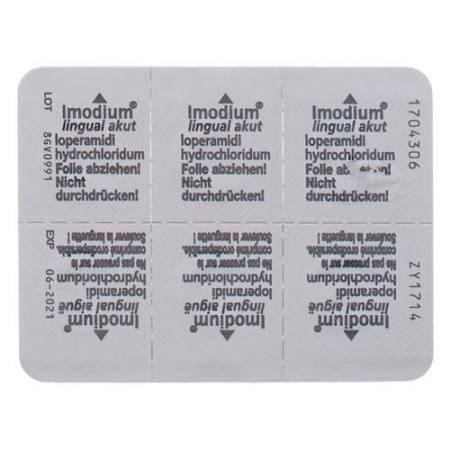

Imodium lingual acute melting tablet 2 mg 12 pcs
Imodium Lingual Akut 2 mg 12 Schmelztabletten
Send a request to get a price
In stock 500 pcsDescription - Imodium lingual acute melting tablet 2 mg 12 pcs
What is Imodium lingual acute and when is it used?
Imodium lingual acute is a highly effective remedy for sudden (acute) diarrhea of ??various causes. It inhibits bowel movement by acting directly on the bowel muscles, making the stool thicker and reducing the number of bowel movements. The effect can occur after about two hours.
When must Imodium lingual acute not be used?
Imodium lingual acute orodispersible tablets should not be given to children under the age of 6 years.
Imodium lingual acute must not be used:
- if you are allergic to loperamide or any of the excipients.if you have severe suffer from liver diseases.if you suffer from severe diarrhea accompanied by high fever and/or mucous-bloody stools.if you have a sudden onset of severe inflammation of the colon (e.g. ulcerative colitis ).if you suffer from bacterial intestinal inflammation caused by pathogens penetrating the intestinal wall.if you have diarrhea that occurs during or after taking antibiotics, suffer.if you suffer from conditions where obstruction of bowel movements is to be avoided, e.g. constipation, bowel obstruction, and abdominal distension.
If you have a suffer from the diseases mentioned, please tell your doctor.
When is caution required when taking Imodium lingual acute?
Although Imodium lingual acute can stop the diarrhea brings, the cause is not treated with Imodium lingual acute. If possible, the cause of the diarrhea should be treated.A sudden attack of diarrhea is usually stopped by Imodium lingual acute within 48 hours. If there is no improvement within 48 hours, you should stop taking Imodium lingual and contact your doctor.If you have AIDS and are taking Imodium lingual to treat the diarrhea, you must contact the Discontinue Imodium lingual acute immediately at the first sign of a distended or swollen abdomen and inform your doctor.Abuse and misuse of loperamide hydrochloride, the active ingredient in Imodium lingual acute, have been reported. Only take Imodium lingual acute for the areas of application described. The maximum daily dose must not be exceeded.
Long-term or regular use of Imodium lingual acute should be under the supervision of a doctor.
Also inform your doctor if if you suffer from liver problems, as you may need acute medical supervision during treatment with Imodium lingual.If you are taking medicines that reduce gastro-intestinal activity, you should tell your doctor , as this could make the effect of Imodium lingual acute too strong.During diarrhea, tiredness, dizziness and lightheadedness can often occur. This may impair the ability to react, the ability to use tools or machines and the ability to drive.Patients suffering from phenylketonuria should note that Imodium lingual acute orodispersible tablets contain 0.75 mg aspartame (equivalent to 0.42 mg phenylalanine).Tell your doctor or pharmacist if you are taking any of the following medicines:
- Ritonavir (used to treat HIV infection)Quinidine (used to treat abnormal heart rhythms)Desmopressin (used to treat increased urination)Itraconazole or ketoconazole (used to treat from fungal infectiontionen)Gemfibrozil (to lower cholesterol levels).
Inform your doctor, pharmacist or druggist or your doctor, pharmacist or druggist if you
- suffer from other diseases,have allergies ortake other medicines (including those you bought yourself!).
May Imodium lingual akut during pregnancy or while breastfeeding?
The doctor must decide whether to take Imodium lingual akut during pregnancy.You should not take Imodium lingual akut while breastfeeding, as small amounts of the active ingredient pass into breast milk.
How do you use Imodium lingual akut?
During diarrhea you lose a lot of liquid. Therefore, make sure that you drink more liquid than usual during the period of diarrhea. This is especially important for children and elderly patients. Your pharmacist can give you a special mix of salt and sugar. Along with water, this also replaces the salts lost during diarrhea. This solution is particularly suitable for children.The dose of Imodium lingual is dependent on age and the type of diarrhea.You can take Imodium lingual at any time of the day.Imodium lingual is placed on the tongue. The orodispersible tablet immediately melts on the tongue and is swallowed with the saliva.
Unless otherwise prescribed by the doctor:
Adolescents and adults
Initial dose: 2 orodispersible tablets
Following dose after each subsequent liquid stool: 1 orodispersible tablet
Maximum daily dose: 8 orodispersible tablets
The maximum duration of treatment with Imodium lingual a kut must not exceed 2 days.
Children from 6 to 12 years of age
Initial dose: 1 orodispersible tabletFollowing dose after each subsequent liquid stool: 1 orodispersible tabletMaximum daily dose: 3 orodispersible tabletsThe maximum duration of treatment with Imodium lingual acute must not exceed 2 days.Once the stool has returned to normal (formed and firm) or if during more than If no more stool has been passed for 12 hours, treatment with Imodium lingual acute should be ended.
Strictly follow the dosage specified in the package leaflet or prescribed by the doctor, especially for children. Do not exceed the stated maximum daily dose.
If you have taken more Imodium lingual acute than you should:
See a doctor as soon as possible, especially if you experience the following symptoms: muscle stiffness, lack of coordination, drowsiness, constricted pupils, increased muscle tone, weak breathing, difficulty urinating, increased heart rate, irregular heartbeat or intestinal blockage. Children may be more sensitive to the CNS effects than adults.
Handling Imodium lingual acute orodispersible tablets:
Since the rapidly disintegrating orodispersible tablets are fragile, Imodium lingual acute orodispersible tablets must not be pushed through the blister as this would damage them.Imodium lingual acute orodispersible tablets are removed from the blister as follows:
- Corner of foil from the mark (Fig. 1)Remove the foil completely (Fig. 2)Bend the blister (Fig. 3)Remove the orodispersible tablet (Fig. 4)
Follow the instructions given in the package leaflet or prescribed by your doctora dosage. If you think the medicine is too weak or too strong, talk to your doctor, pharmacist or druggist.
What side effects can Imodium lingual acute have?
The following side effects can occur when taking Imodium lingual acute:Common (affects 1 to 10 in 100 users): Headache, dizziness, constipation , nausea, flatulenceUncommon (affects 1 to 10 users in 1000): abdominal or upper abdominal pain, abdominal discomfort, dry mouth, vomiting, indigestion, rashSide effects which have been observed in post-marketing experience and the frequency of which cannot be determined: abdominal distension, hypersensitivity reactions, impaired concentration, reduced consciousness, increased muscle tone, unconsciousness, sch Drowsiness, muscle stiffness, constriction of the pupils, bowel obstruction or dilatation, severe skin reaction, difficulty urinating, itching, tiredness.
In rare cases, a burning or tingling sensation may occur on the tongue immediately after taking Imodium lingual acute orodispersible tablets, which will quickly subside.
If you notice any side effects, contact your doctor, pharmacist or druggist . This also applies in particular to side effects that are not listed in this leaflet.Stop treatment with Imodium lingual acute and inform your doctor immediately if you observe or suspect any of the following symptoms. If this happens you may need urgent treatment.
- sudden swelling of the face, lips or throat, difficulty breathing, hives (also known as hives or urticaria), severe irritation, redness or blistering of the skin. These symptoms may be signs of hypersensitivity or an allergic reaction.extreme tiredness, incoordination, loss of consciousness.severe abdominal pain, abdominal swelling or fever, which could indicate a blockage or dilation of the bowel.
Some adverse events that have been reported with loperamide are commonly symptoms of the underlying diarrhea (abdominal pain, malaise, nausea, vomiting, dry mouth, tiredness, drowsiness, dizziness, constipation and flatulence). These symptoms are often difficult to distinguish from adverse events.
What else needs to be considered?
Like all medicines, Imodium lingual acute should be stored away from children.The medicine may only be used up to the date marked «EXP» on the package.
Storage instructions
Store at room temperature (15-25 °C). The preparation is sensitive to moisture and must not be stored outside the blister.
Further information
Return expired medicines to your pharmacist.Your doctor, pharmacist or druggist can provide you with further information. These people have the detailed technical information.
What does Imodium lingual acute contain?Active substances
1 Imodium lingual acute orodispersible tablet contains 2 mg loperamide hydrochloride; ExcipientsGelatine, mannitol, aspartame, sodium bicarbonate, mint flavor (contains vanillin).
Authorization number
58059 (Swissmedic).
Where can you get Imodium lingual diarrhea acute? What packs are available?
In pharmacies and drugstores, without a doctor's prescription:
Packs of 10 orodispersible tablets.Packages of 12 orodispersible tablets.
Authorization holder
Janssen-Cilag AG, Zug, ZG.This leaflet was last checked by the drug authority (Swissmedic) in MAY 2018.