

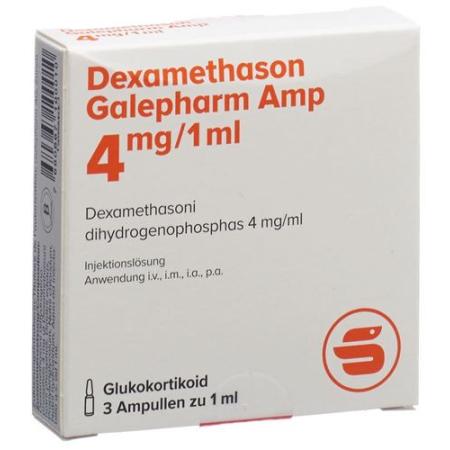
Dexamethasone Galepharm Amp Inj Lös 4 mg/ml 3 x 1 ml
Dexamethason Galepharm Amp Inj Lös 4 mg/ml 3 x 1 ml
Send a request to get a price
In stock 50 pcsDescription - Dexamethasone Galepharm Amp Inj Lös 4 mg/ml 3 x 1 ml
Composition
Active ingredients
Dexamethasoni dihydrogenophosphas ut Dexamethasoni natrii phosphas.
Auxiliary materialsDexamethason Galepharm Amp 4 mg / 1 ml
Propylenglycolum (E 1520) 20 mg of Sodium Chloride, Dinatrius edetas, Sodium Hydroxide, Water for injectible Qs to a solution for 1 ml, corresp. 3.7 mg Sodium.
Dexamethason Galepharm Amp 8 mg / 2 ml
Propylenglycolum (E 1520) 40 mg, Sodium Chloride, Dinatrius edetas, Sodium hydroxide, water to be injected into the solution for 2 ml, corresp. 7.4 mg Sodium.
Dosage form and amount of active ingredient per unit
1 ampoule of Dexamethason Galepharm Amp 4 mg / 1 ml contains 4 mg of Dexamethasoni dihydrogenophosphas corresponding to 3.32 mg of dexamethasone.1 ampoule of Dexamethason Galepharm Amp 8 mg / 2 ml contains 8 mg of dexamethasoni dihydrogenophosphas corresponding to 6.64 mg of dexamethasone.
Indications / possible usesSystemic application
Brain edema (triggered by brain tumor, head trauma, intracerebral hemorrhage, neurosurgical interventions, brain abscess, apoplexy, encephalitis, meningitis, radiation damage). Anaphylactic shock (after primary adrenaline injection). Polytraumatic shock (prophylaxis of shock lung and fat embolism). Status asthmaticus. Acute relapses of severe dermatoses (e.g. Quincke's edema, pemphigus vulgaris, uncontrollable eczema, cutaneous sarcoid). Acute blood diseases (e.g. acute hemolytic anemia). Acute primary and secondary adrenal insufficiency (but only with simultaneous therapy with a mineralocorticoid). Prophylaxis and therapy of cytostatics-induced vomiting.Treatment of coronavirus disease 2019 (COVID-19) in adults and adolescents (aged at least 12 years and weighing at least 40 kg) who require additional oxygen.
Local application
Periarticular and infiltrative therapy, e.g. for humeroscapular periarthritis, epicondylitis, bursitis and tendovaginitis. Intra-articular injection, for example in rheumatoid arthritis, when individual joints are affected or only react inadequately to general treatment and in the case of arthrosis deformans (accompanying inflammatory reaction).
Dosage / application
Parenteral administration of glucocorticoids should be reserved for emergency situations and situations in which oral therapy is impossible or undesirable.
General dosage instructions
Dexamethasone is given in an individual dose, taking into account the severity and course of the disease, the patient's response, and the expected duration of treatment. It should also be determined whether daily or intermittent therapy is indicated. Possible complications depend on the dosage and the duration of therapy.Since the full effect of dexamethasone, as with all glucocorticoids, is delayed (after 1-2 hours), the preparation should never be administered in life-threatening situations (e.g. status asthmaticus, acute cerebral edema) without additional immediate therapy.As soon as the acute phase has been overcome, an initially high parenteral dosage should be gradually reduced and replaced by oral administration.If there is no improvement within a few days, parenteral administration of glucocorticoids should not be continued.Long-term treatment should only be carried out after careful assessment of the benefit and risk. Patients should be carefully monitored for signs that require a dose reduction or medication discontinuation.As with all glucocorticoid therapy, treatment with Dexamethasone Galepharm should not be stopped suddenly, but rather ended by slowly reducing the daily dose gradually in order to avoid worsening or acute recurrence of the disease, acute adrenal insufficiency and cortisone withdrawal syndrome.In the event that Dexamethason Galepharm is to be used instead of other glucocorticoids, the equivalent doses must be taken into account (see ?Properties / Effects?).
Systemic application
In acute forms of cerebral edema, eg after traumatic brain injuries, intracerebral bleeding and strokes: initially 40-100 mg iv; after 2-4 days 4-8 mg iv or im at 2- to 4-hour intervals over 5-8 days.For subacute and chronic forms of brain edema, eg brain tumors, brain abscesses, meningoencephalitis and radiation damage: initially 8-12 mg iv; Continuation of therapy with 4 mg iv or im at 6-hour intervals.For the initial treatment of anaphylactic shock (after primary adrenaline injection) and shock due to multiple injuries (prophylaxis of shock lung or fat embolism): 40-200 mg iv In severe cases, either repeat the initial dose after 4-12 hours or administration of 16-40 mg 6 - every hour for 2-3 days ivFor status asthmaticus: initially 40-80 mg iv; Depending on the severity of the case, repeat the initial dose after 3-6 hours and continue treatment with 4 mg iv per day and, if necessary, switch to oral therapy.For acute dermatoses and acute blood diseases: initially 16-40 mg iv, further oral treatment.For the therapy of acute adrenal insufficiency (Addison's crisis): Initiation of therapy with 8-16 mg iv (but only with simultaneous therapy with a mineralocorticoid).For the prophylaxis and therapy of cytostatic-induced vomiting: one 8 mg ampoule iv on the day before therapy, 8-12 mg iv at the start of therapy, then 4 mg iv every 4-6 hours for at least 48 hoursTo treat COVID-19, adult patients are given 6 mg intravenously once a day for up to 10 days. The duration of treatment depends on the clinical response and the individual needs of the patient.
Local application
For local infiltrative, periarticular and intraarticular therapy under strictly aseptic conditions, injection of 4 or 8 mg. For an injection into a very small joint, 2 mg is sufficient. Depending on the severity of the disease, no more than 3-4 infiltrations or 3-4 injections per joint should be made. The interval between injections should not be less than 3-4 weeks.
Long-term treatment
Long-term treatment for more than 2 weeks can lead to adrenal insufficiency by inhibiting the release of ACTH, which can go as far as atrophy of the adrenal cortex. The functional failure of the adrenal cortex can last up to a year or longer and means a life-threatening risk for the patient in stressful and stressful situations.The disturbed stress reaction during long-term glucocorticoid therapy makes it necessary to adapt the corticosteroid dose to stress conditions. Hydrocortisone iv is usually used for this:
- For general illnesses: double, possibly triple the last dose of dexamethasone givenFor minor interventions : an additional 100 mg hydrocortisone iv before the startFor medium-sized interventions : before the operation, 100 mg hydrocortisone iv and then every 6 hours 100 mg hydrocortisone for 24 hoursFor major surgical interventions : additionally 100 mg hydrocortisone before the start of the operation and then every 6 hours for at least 72 hours. Further treatment depending on the course
Correct way of application
Dexamethason Galepharm ampoules are injected intravenously, intramuscularly, locally infiltratively or intraarticularly.Local infiltration and intra-articular injection must be carried out under strictly aseptic conditions. The skin is prepared as for the operation (if necessary, shaving, degreasing, alcohol, iodine coating). Injections into tendons should be avoided.
Special dosage instructionsChildren and adolescents
The dosage should be based more on the severity of the disease and the response to therapy than on age, body weight or height. In infants and children aged 0-11 years, lower doses than adults are generally sufficient. After an adequate response, the dose of dexamethasone should be reduced in small steps to the lowest possible dose and discontinued as soon as possible.
iv Anwendung
- Brain edema triggered e.g. by:
- Brain tumor: initially 0.5-1 mg / kg, then 0.25-0.5 mg / kg per day divided into 4 dosesneurosurgical interventions: preoperatively 1 mg / kg, then 0.2 mg / kg every 4 hours for 24 hoursEncephalitis / meningitis: 0.15 mg / kg every 6 hours for 4 days or 0.4 mg / kg every 12 hours for 2 days, starting before the first antibiotic therapy
Initially: infants 7.5-15 mg, older children 4.5 mg / kg, 2nd day: dose reduction to half the initial dose, 3rd day: dose reduction to a quarter of the initial dosePolytraumatic shock (prophylaxis of shock lung and fat embolism):
Initial: infants 7.5-15 mg, older children 4.5 mg / kg, 2nd day: dose reduction to half the initial dose, 3rd day: dose reduction to a quarter of the initial doseStatus asthmaticus:
Initially: Bolus of 7.5-15 mg, then 0.15-0.3 mg / kg per dayAcute relapses of severe dermatoses (e.g. quincke edema, pemphigus vulgaris, uncontrollable eczema, cutaneous sarcoidosis):
Dosage depending on severity: high dosage 0.3-0.45 mg / kg, medium dosage 0.15 mg / kg, maintenance dose 0.04 mg / kg, each per dayAcute blood diseases (eg acute haemolytic anemia):
Depending on the severity of the disease, 6.5-40 mg / m 2 body surface area for 4-5 days every 28 daysAcute primary and secondary adrenal insufficiency (if hydrocortisone is not available, but only with simultaneous therapy with a mineralocorticoid):
Initially infants 7.5-15 mg, older children 4.5 mg / kg, then switch to hydrocortisoneProphylaxis and therapy of cytostatics-induced vomiting:
About 30 minutes before chemotherapy 8 mg / m 2 body surface area, then 16 mg / m 2 in 2-4 divided doses over the day
Treatment of COVID-19:Patients with liver dysfunction
No dose adjustments are required.
Patients with impaired renal function
No dose adjustments are required.
Elderly patients
No dose adjustments are required.
Children and adolescents
For pediatric patients (adolescents 12 years of age and older), a dose of 6 mg intravenously once daily for up to 10 days is recommended. The duration of treatment depends on the clinical response and the individual needs of the patient. Limited data are available for patients under the age of 18.
Contraindications
There are no contraindications for acute use in conditions in which the administration of glucocorticoids can save lives.In the event of hypersensitivity to one of the ingredients, the drug must not be used.Intra-articular injection is contraindicated in the following cases:
- Infection of the joint resp. the joint environmentBacterial arthritisJoint instabilityBleeding tendency (spontaneous or as a result of anticoagulant therapy)Periartikuläre KalzifikationAvaskuläre OsteonekroseTorn tendonCharcot joint
Infiltration without additional causal therapy is contraindicated for infections in the area of ??application.
Warnings and Precautions
Treatment with Dexamethason Galepharm can cause immunosuppression and thereby increase the risk of bacterial, viral, fungal, parasitic and opportunistic infections. In addition, Dexamethason Galepharm can mask the symptoms of an existing or developing infection and thus make diagnosis more difficult. Latent infections, including tuberculosis or hepatitis B, can be reactivated.As with all glucocorticoid therapy, treatment with Dexamethasone Galepharm should not be stopped suddenly, but rather ended by slowly reducing the daily dose gradually in order to avoid worsening or acute recurrence of the disease, acute adrenal insufficiency and cortisone withdrawal syndrome.In COVID-19 patients who are already being treated with systemic (oral) corticosteroids for other reasons (e.g. patients with chronic obstructive pulmonary disease) but who do not require additional oxygen, the systemic corticosteroids should not be discontinued.
Caution is advised with:
- acute viral infections (hepatitis B, chickenpox, herpes zoster, herpes simplex, herpetic keratitis, poliomyelitis, measles). If immunosuppressed patients or patients without previous chickenpox or measles infection come into contact with measles or chickenpox sufferers during Dexamethasone Galepharm therapy, particular caution is required. These diseases can be particularly severe in patients on Dexamethason Galepharm therapy. Chickenpox infections that occur during systemic treatment with corticosteroids can be severe and be fatal, especially in children. They require immediate treatment, e.g. IV acycloviracute and chronic bacterial infections: use only under antibiotic protection. A latent amebiase must be ruled out before treatment, and patients with latent tuberculosis or organ tuberculosis must receive prophylactic tuberculostatics during long-term treatment with glucocorticoidssystemic mycoses and parasitoses. In patients with known or suspected strongyloid infestation, glucocorticoids can cause the disease to recur or spreadabout 8 weeks before to 2 weeks after vaccinations with live vaccines. In principle, vaccinations with dead vaccines are possible. It should be noted, however, that the immune response and thus the success of the vaccination may be reduced with higher glucocorticoid dosesLymphadenitis after BCG vaccinationHBsAg positive, chronic Hepatitisdiabetes mellitus difficult to control, as glucose tolerance may be reduced; Regular blood sugar checks should be carried out and, if necessary, the dose of antidiabetic drugs should be adjustedHypothyroidism and cirrhosis of the liver, since in such cases the effect of glucocorticoids is increasedThromboseneigungacute heart attackdifficult-to-control hypertension and heart failureMyasthenia gravis and simultaneous administration of cholinesterase inhibitors, as in such cases the effect of the cholinesterase inhibitors is reduced and the risk of a myasthenic crisis is increased. (Cholinesterase inhibitors should be discontinued 24 hours before administration of a corticosteroid whenever possible)Gastrointestinal ulcersosteoporosisPsychiatric illnesses including suicidality (including anamnestic): Neurological or psychiatric monitoring is recommendedNarrow-angle and wide-angle glaucoma, corneal ulcers or injuries: Close ophthalmic monitoring and therapy are recommended
Because of the risk of intestinal perforation, Dexamethason Galepharm may only be used if there is a compelling indication and under appropriate supervision:
- Severe ulcerative colitis without peritoneal irritation with impending perforationDivertikulitisEnteroanastomoses (immediately postoperatively)
Symptoms of peritoneal irritation following gastrointestinal perforation may be absent in patients receiving high doses of glucocorticoid.If fluoroquinolones are used at the same time, there is an increased risk of tendon discomfort, tendinitis and torn tendons.During stressful physical situations, a temporary increase in the daily dose of corticosteroids may be necessary.Severe anaphylactic reactions can occur which require appropriate precautionary measures (readiness to treat anaphylactic shock).In the case of high doses, care should be taken to ensure adequate potassium intake and sodium restriction. The serum potassium level should also be monitored.Bradycardia can occur at high doses.In the case of local application, attention must be paid to the possible occurrence of systemic adverse effects and interactions.Intra-articular use of glucocorticoids increases the risk of developing joint infections. A long-term use resp. repeated use of glucocorticoids on weight-bearing joints can lead to increased signs of wear and tear.Tumor lysis syndrome (TLS) has been reported in patients with haematological malignancies after the use of dexamethasone alone or in combination with chemotherapeutic agents. Patients with tumors with a high proliferation rate or high sensitivity to cytotoxic agents, as well as patients with a high tumor burden, have a high risk of developing TLS and should therefore be monitored closely. In addition, appropriate precautionary measures should be taken.
Pheochromocytoma crisis
Pheochromocytoma crisis, which can be fatal, has been reported following the use of corticosteroids. Corticosteroids should only be used in patients with suspected or diagnosed pheochromocytoma after an appropriate risk-benefit assessment.
Visual disturbances
Visual disturbances can occur with systemic or local treatment with corticosteroids. If symptoms such as blurred vision or other visual disturbances occur, the patient should be referred to an ophthalmologist for possible causes such as cataract, glaucoma, or rare diseases such as central serous chorioretinopathy that have occurred during treatment with systemic or local corticosteroids.
Premature babies
After early therapy (
Children and adolescents
The use of Dexamethason Galepharm during the growth phase of children should only be carried out after carefully weighing the benefits and risks. Either intermittent or alternating therapy should be used.
Elderly patients
As elderly patients have an increased risk of osteoporosis, Dexamethason Galepharm should only be used after careful assessment of the benefit and risk.
Auxiliary materialssodium
This medicinal product contains less than 1 mmol sodium (23 mg) per ml, ie it is essentially «sodium-free».
Propylene glycol
Dexamethason Galepharm Amp: 4 mg / 1 ml: This medicinal product contains 20 mg propylene glycol per 1 ml, corresponding to 20 mg / ml.Dexamethason Galepharm Amp: 8 mg / 2 ml: This medicinal product contains 40 mg propylene glycol per 2 ml, equivalent to 20 mg / ml.Concomitant use with an alcohol dehydrogenase substrate - such as ethanol - can cause serious side effects in newborns.
Interactions
drugChange in effect |
|---|
Saluretika, Amphotericin, Laxantienadditional potassium excretionMedicines that induce CYP3A4 such as rifampicin, phenytoin, carbamazepine, barbiturates and primidoneReduced effectiveness of the corticosteroids by increasing clearanceMedicines that inhibit CYP3A4 such as ketoconazole, itraconazole, ritonavir and cobicistatThe risk of systemic corticosteroid side effects may be increasedEphedrineReduced effectiveness through accelerated corticosteroid metabolismNonsteroidal anti-inflammatory / anti-inflammatory drugsGastrointestinal bleeding, ulceration and perforation risk increasedSalizylateReduced effectiveness of salicylates by increasing clearance. |
Pregnancy / lactationpregnancy
Animal studies have shown adverse effects on the fetus; no controlled human studies exist. Like all glucocorticoids, dexamethasone crosses the placental barrier. In the case of long-term therapy during pregnancy, intrauterine growth disorders, for example, cannot therefore be ruled out. Treatment at the end of pregnancy poses a risk for the fetus of adrenal cortex atrophy, which may require gradual substitution therapy in the newborn.Therefore, like all glucocorticoids, Dexamethason Galepharm should not be used during pregnancy - and especially during the first three months - unless clearly necessary. In the case of an existing indication, prednisolone (or prednisone) should be preferred to all other - and especially the fluorinated - glucocorticoids, as it is least able to penetrate the placenta.If a pregnancy is suspected or has occurred, the doctor should be informed.Children whose mothers were treated with higher doses of glucocorticoid during pregnancy should be carefully monitored for signs of hypocorticism.
Breastfeeding
Like all other glucocorticoids, dexamethasone passes into breast milk in very small amounts and could, among other things, impair the function of the adrenal glands and the growth of the baby. Mothers who receive glucocorticoids while breastfeeding should therefore stop breastfeeding.
Effects on ability to drive and use machines
Changes in the ability to drive and use machines may occur, especially when starting treatment with Dexamethason Galepharm. This impairment is particularly due to changes in mood, drive and ability to concentrate.
Unwanted effects
The undesirable effects of dexamethasone depend on the dose and duration of treatment, as well as on the age, gender and underlying disease of the patient.The risk of adverse effects is low with short-term corticosteroid therapy. However, one should watch out for intestinal bleeding (often due to stress), which can be asymptomatic due to the use of corticosteroids.In the case of long-term high-dose therapy, the known side effects of glucocorticoids can occur.
Infections and parasitic diseases
Increasing the risk of infection, masking infections, occurrence, aggravation or reactivation of bacterial, viral, fungal, parasitic and opportunistic infections, activation of strongyloidiasis.
Blood and lymphatic system disorders
Moderate leukocytosis, lymphopenia, eosinopenia, polycythemia.
Immune system disorders
Hypersensitivity reactions, serious anaphylactic reactions such as arrhythmia, bronchospasm, increase or decrease in blood pressure, circulatory failure, cardiac arrest.In the case of local application, possible systemic undesirable effects and interactions must be taken into account.
Endocrine Disorders
Adrenal insufficiency.Cushing's syndrome (eg full moon face, trunk obesity) see «Warnings and precautionary measures».
Metabolism and nutrition disorders
Sodium retention with edema formation, increased potassium, calcium and phosphate excretion.Weight gain, decreased glucose tolerance, diabetes mellitus, hypercholesterolemia, hypertriglyceridemia, increased appetite.
Psychiatric illnesses
Psychosis, mania, depression, hallucinations, affect lability, irritability, increased drive, euphoria, inner restlessness, sleep disorders, suicidality.
Nervous system disorders
Increased intracranial pressure with congestive papilla (pseudotumor cerebri), occurrence or worsening of epilepsy (convulsions).
Eye diseases
Increase in intraocular pressure (glaucoma), opacity of the lens (cataract), especially with posterior subcapsular opacity, worsening of symptoms in corneal ulcers, promotion of viral, fungal and bacterial eye infections, worsening of bacterial corneal infections, ptosis, mydriasis, chemosis, iatrogenic scleral perforation, rarely reversible scleral perforation. Also with subconjunctival use keratitis (caused by herpes simplex viruses) and corneal perforations in keratitis, chorioretinopathy, blurred vision.
Vascular diseases
Hypertension.Increase in the risk of atherosclerosis and thrombosis, vasculitis, increase in capillary fragility.
Gastrointestinal disorders
Peptic ulcers in the stomach and duodenum, bleeding in the stomach, inflammation of the pancreas, stomach discomfort.
Skin and subcutaneous tissue disorders
Striae rubrae, perioral dermatitis, skin atrophy, punctiform skin bleeding (petechiae), bruising (ecchymosis), steroid acne, delayed wound healing, telangiectasia, hypertrichosis, changes in skin pigmentation.
Musculoskeletal, connective tissue and bone diseases
Muscle atrophy, muscle weakness, myopathy, tendon discomfort, tendonitis, tendon tears, osteoporosis, aseptic bone necrosis, growth retardation in children, epidural lipomatosis.
Reproductive system and breast disorders
Disorders of sex hormone secretion (lack of menstrual bleeding, abnormal hair growth, impotence).
General disorders and administration site conditions
Delayed wound healing. Repeated intramuscular, intraarticular and sublesional administration of dexamethasone (or another glucocorticoid) can lead to severe local tissue damage (up to atrophy and necrosis).Reporting suspected side effects after approval is of great importance. It enables continuous monitoring of the benefit-risk balance of the medicinal product. Health professionals are requested to report any suspected new or serious side effects via the online portal ElViS (Electronic Vigilance System). You can find information on this at www.swissmedic.ch.
Overdose
Since the acute toxicity of glucocorticoids is low, intoxications caused by acute overdose of glucocorticoids have only rarely been observed. In the case of chronic overdose, increased undesirable effects are to be expected, which in particular affect the endocrinium, metabolism and electrolyte balance. There is no specific antidote in the event of overdose and treatment is symptomatic.
Properties / effectsATC-Code
H02AB02
Mechanism of action
The mechanism of action of glucocorticoids is multilayered.Dexamethasone binds to intracellular receptors and activates them. The activated glucocorticoid receptor complex migrates into the cell nucleus, where it initiates or blocks the synthesis of certain proteins at specific DNA binding sites.
- The proteins whose synthesis is initiated include lipocortin 1, which inhibits phospholipase A 2 , which is important for an inflammatory reaction , and angiotensin converting enzyme (ACE), which intervenes in the blood pressure control circuitThe proteins whose synthesis is inhibited include various cytokines (e.g. TNF-alpha, interleukin-2, interleukin-6), which activate cells of the immune system, and various proinflammatory enzymes (e.g. collagenase). The induction of NO synthetase and cyclooxygenase are also prevented
In addition to these genomic mechanisms, which start with a latency of half an hour to several hours, there are some rapid effects, some of which already start at low plasma concentrations (e.g. suppression of endogenous cortisol secretion), and others that only become effective at higher concentrations ( e.g. membrane stabilization). The most likely mechanism for the latter is the incorporation of the glucocorticoids into the cell membrane as the initial event.
Pharmakodynamik
Dexamethasone has a strong anti-inflammatory, anti-allergic (anti-edematous) and immunosuppressive effect, increases carbohydrate metabolism, non-specific anti-toxic (membrane protection) and promotes microcirculation (stabilization of cerebral blood flow).Dexamethasone has very little mineralocorticoid activity.The relative anti-inflammatory equivalent dose of dexamethasone compared to other glucocorticoids is 1 mg dexamethasone = 6 mg triamcinolone or methylprednisolone = 7.5 mg prednisone or prednisolone = 30 mg hydrocortisone = 35 mg cortisone.
Clinical effectiveness
Like other glucocorticosteroids, dexamethasone is used for a wide range of indications. Due to its long biological half-life, dexamethasone is particularly suitable for those indications in which a continuous glucocorticoid effect is desired. In some indications, dexamethasone is preferred due to its low mineralocorticoid effect.
To treat COVID-19
The RECOVERY study (Randomized Evaluation of COVid-19 thERapY) is a research-initiated, individually randomized, controlled, open, adaptive platform study to evaluate the effect of possible treatments on patients treated for COVID-19 in hospital.The study was carried out in 176 hospitals in the UK.6425 patients were randomized to receive either dexamethasone (2104 patients) or the usual standard therapy (4321 patients). SARS-CoV-2 infection was confirmed in the laboratory in 89% of the patients.When randomized, 16% of the patients were already receiving invasive mechanical ventilation or extracorporeal membrane oxygenation, 60% received oxygen only (with or without non-invasive ventilation) and 24% received no respiratory support.The mean age of the patients was 66.1 +/- 15.7 years. 36% of the patients were female. 24% of the patients had a history of diabetes, 27% had cardiovascular disease and 21% a chronic lung disease.
Primary endpoint
The 28-day mortality rate was significantly lower with 482 deaths in 2104 patients (22.9%) in the dexamethasone group than in the standard therapy group with 1110 of 4321 patients (25.7%) (rate ratio [rate ratio, RR]: 0.83; 95%) -Confidence interval [CI]: 0.75-0.93; p In the dexamethasone group, the mortality rate was higher in the patients who received invasive mechanical ventilation (29.3% vs. 41.4%; RR: 0.64; 95% CI: 0.51-0.81) as well as in the patients who received only supplemental oxygen without invasive mechanical ventilation (23.3% vs. 26.2%; RR: 0.82; 95% CI: 0.72-0.94), lower than in the standard therapy group.There was no clear effect of dexamethasone in patients who were randomized to receive no respiratory support (17.8% vs. 14.0%; RR: 1.19; 95% CI: 0.91-1.55).
Secondary endpoints
The patients in the dexamethasone group had a shorter stay in the hospital than those in the standard therapy group (median, 12 days vs. 13 days) and a greater probability of being discharged from the hospital within 28 days (RR: 1.10; 95% -KI: 1.03-1.17).Consistent with the primary endpoint, the greatest effect in terms of hospital discharge within 28 days was seen in patients who received invasive mechanical ventilation after randomization (RR: 1.48; 95% CI: 1.16-1.90), followed by the group who received received only oxygen (RR: 1.15; 95% CI: 1.06-1.24). There was no positive effect in patients who received no oxygen (RR: 0.96; 95% CI: 0.85-1.08).
ResultDexamethason | |||
Primary result28-day mortality482/2104 (22.9)1110/4321 (25.7)0.83 (0.75-0.93) Secondary resultsDischarge from hospital within 28 days1413/2104 (67.2)2745/4321 (63.5)1.10 (1.03-1.17)Invasive mechanical ventilation or death456/1780 (25.6)994/3638 (27.3)0.92 (0.84-1.01)
102/1780 (5.7)285/3638 (7.8)0.77 (0.62-0.95)
387/1780 (21.7)827/3638 (22.7)0.93 (0.84-1.03) | |||
* RRs were age-adjusted for outcomes of 28-day mortality and hospital discharge. RR were age-adjusted for outcome of maintenance of invasive mechanical ventilation or death and its sub-components.Patients who were already receiving invasive mechanical ventilation when randomized were excluded from this category.
safety
There were four study treatment-related Serious Adverse Events (SAEs): two hyperglycemic SAEs, one steroid-induced psychosis SAE, and one upper gastrointestinal haemorrhage SAE. All events subsided.
SubgruppenanalysenEffects of assignment to the dexamethasone group on 28-day mortality, by age and randomized breathing support

Effects of assignment to the dexamethasone group on 28-day mortality, according to randomized breathing assistance and history of chronic illness

PharmacokineticsAbsorption
After intravenous injection of dexamethasone-21-dihydrogen phosphate, hydrolysis of the ester occurs very quickly. In humans, maximum blood levels of free dexamethasone alcohol appear 10 minutes after injection of the ester. Dexamethasone-21-dihydrogen phosphate injected intramuscularly is quickly and practically completely absorbed with normal blood flow, with maximum blood levels being reached 60 minutes after the IM application. However, the maximum pharmacological effect is delayed (approximately 2 hours after injection) and lasts longer than the plasma half-life.
Distribution
4 hours after intravenous administration of dexamethasone-21-dihydrogen phosphate, maximum dexamethasone CSF levels are present, which are approximately one sixth of the simultaneous plasma concentration. The drop in the dexamethasone level in the CSF occurs only slowly, so that 24 hours after inject. about two thirds of the maximum concentration can still be found.Dexamethasone is dose-dependently bound to plasma proteins, mainly to plasma albumin, up to 80%. In the range of very high doses, the largest part circulates freely, ie not bound to protein, in the blood.The volume of distribution of dexamethasone is 0.6-0.8 l / kg.In hypoalbuminemia, the proportion of unbound (effective) corticosteroid increases.Dexamethasone crosses both the blood-brain and placental barriers and is excreted in breast milk.
Metabolism
Dexamethasone is mainly excreted unchanged by the kidneys. Only a small part of the molecules is hydrogenated or hydroxylated in humans, with 6-hydroxydexamethasone and 20-dihydrodexamethasone being formed as the main metabolites. 30-40% of the dexamethasone molecules are bound to glucuronic acid or sulfuric acid in the human liver and appear in this form in the urine.
Elimination
The plasma elimination half-life of dexamethasone is 3-5 hours, with the biological half-life being considerably longer at 36-72 hours. The plasma clearance in adults is 2-5 ml / min / kg. Dexamethasone is completely eliminated after a local infiltrative and intra-articular injection of 4 mg and 8 mg doses with normal blood flow to the application site after an average of 4-10 days.
Kinetics of special patient groups
The elimination half-life is prolonged during pregnancy.
Liver dysfunction
Severe liver diseases (e.g. hepatitis, liver cirrhosis) and hypothyroidism prolong the elimination half-life.
Kidney dysfunction
Renal impairment does not significantly affect the elimination.
Children and adolescents
Plasma clearance is lower in newborns than in children and adults.
Preclinical data
Glucocorticoids have very low acute toxicity.
Long-term toxicity (or repeated dose toxicity)
No information is available on chronic toxicity in humans or animals.
Mutagenicity
Dexamethasone has not been adequately studied for mutagenic effects. There are preliminary indications of a mutagenic potential, the relevance of which has not yet been clarified.
Carcinogenicity
Long-term studies on animals are not available.
Reproductive toxicity
In animal experiments, dexamethasone causes cleft palates in mice, rats, hamsters, rabbits and dogs and, to a lesser extent, other malformations.
Other notesIncompatibilities
Dexamethason Galepharm Amp should not be mixed with other medicinal products. For compatibility with infusion solutions, see «Instructions for use».
Influencing diagnostic methodsAllergietests
Skin reactions can be suppressed.
Blood serum values
Decreased : ESR, clotting time (Lee White), uric acid, testosterone, potassium, TSH, thyroxine, T 3 .Increases : glucose, cholesterol, sodium, chloride.
Urine values
Erniedrigt : 17-Ketosteroide.Increased : creatinine, calcium, glucose (with predisposition).
durability
The drug may only be used up to the date marked ?EXP? on the container.
Special storage instructions
Do not store above 25 ° C. Do not store in the refrigerator. Do not freeze. Store in the original package in order to protect from light.Keep out of reach of CHILDREN.
Instructions for useCompatibility with infusion solutions
Dexamethason Galepharm Amp should be administered intravenously as directly as possible or injected into the infusion tube.Dexamethason Galepharm Amp is compatible with the following infusion solutions and is intended to be used within 24 hours: Isotonic saline solution and 5% glucose solution.When combined with infusion solutions, the information provided by the respective providers about their infusion solutions, including compatibility, contraindications, undesirable effects and interactions, must be observed.
Approval number
66710 (Swissmedic).
Marketing authorization holder
Galepharm AG, Zurich?