

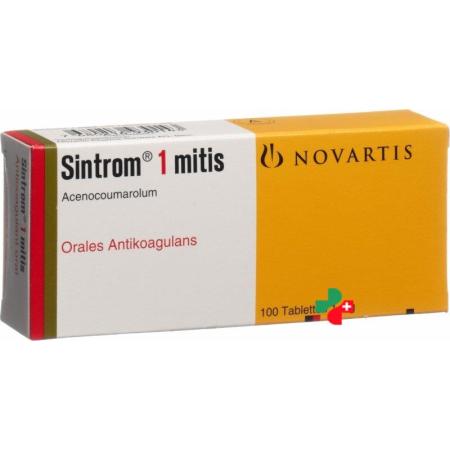
Sintrom 1 mitis Tabl 1 mg 100 pcs
Sintrom 1 Mitis 1 mg 100 tablets
Send a request to get a price
In stock 50 pcsAnalogues of the product based on the Anatomical Therapeutic Chemical (ATC) Classification - B01AA07
| Name | Code | EAN | Price | Original | ||
|---|---|---|---|---|---|---|
 |
Sintrom 1 mitis tabl 1 mg 1000 pcs | 166717 | 7680216930228 | - | Read more | |
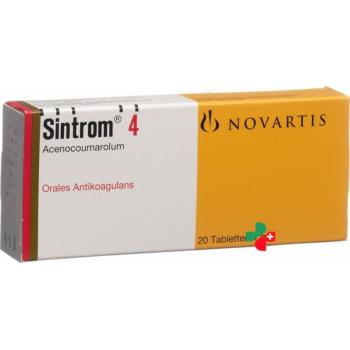 |
Sintrom 4 tablets 4 mg 20 pcs | 166723 | 7680216930303 | - | Read more |
Description - Sintrom 1 mitis Tabl 1 mg 100 pcs
What is Sintrom and when is it used?
Prescriptened by your doctor.Sintrom is a medicine that contains the active substance acenocoumarol. Acenocoumarol belongs to a group of medicines called anticoagulants.Sintrom inhibits the blood's tendency to clot and can thus prevent the formation of solid blood clots (thrombi). Pre-existing blood clots will not be dissolved, but pre-existing ones will be prevented from growing.It is used on a doctor's prescription if there is a risk of thrombosis (due to clot formation) being expected. If you take a certain dose of Sintrom daily, the tendency to coagulate drops to the desired values. Regular intake and periodic controls of the coagulation activity are necessary so that these values ??can be maintained in an optimal range, which is necessary for the prevention of thrombosis. If the latter is not adhered to, there is a risk of bleeding if the doses are too high or the reaction is severe; if the doses are too low or the reaction is insufficient, the risk of blood clots is not reduced.
Control of blood thinning
Various methods or techniques are suitable for this control, one of the best known is known as the ?quick test?. For this purpose, blood samples are taken every day before the treatment and afterwards for approx. 3-4 days in the doctor's laboratory to determine the coagulation activity. If the Quick value is set, the checks are carried out at longer intervals, but at the same time of day.
What precautions should be taken?
In certain cases, your doctor will provide you with an antidote (vitamin K) to prevent bleeding, which you always carry with you and which must be taken as directed by a doctor if bleeding occurs.
When should Sintrom not be taken?
Do not use Sintrom if you:
- have ever had unusual or allergic (hypersensitive) reactions to acenocoumarol or other medicines with a similar structure or to other components of the Sintrom tablet,are likely to have problems following the prescribed regimen exactly (e.g. elderly patients who are not monitored, patients with an alcohol problem, patients with psychiatric illnesses)have a severe bleeding disorder (e.g. haemophilia) or a blood disorder with a tendency to bleedrecently had an operation on the eye, brain or teeth, or other major operations (lungs, prostate, uterus) during which you were bleeding profusely, or if you are about to have such an operation,have a stomach ulcer, bleeding from the intestines, bleeding from the urinary or genital organs, bleeding into the brain (stroke) or bleeding from the lungs,have a heart infectionhave uncontrolled high blood pressure (hypertension)have severe liver or kidney diseaseare pregnant or think you may be pregnant.
If you are unsure, talk to your doctor or pharmacist.
When is caution required when taking / using Sintrom?
Before using Sintrom, tell your doctor or health care professional if you:
- have liver disease.have a kidney or thyroid disorder, tumor, infection, inflammation, or disorders that affect the ability of the stomach or small intestine to absorb food. These diseases can affect the concentration of the active substance in the blood.suffer from severe heart and / or circulatory disease.be irradiated.have diabetes.are deficient in protein C or S (types of blood clotting factors).if you are about to have an operation that may affect your bleeding tendencies, such as minor surgery, tooth extraction, lumbar puncture or angiography.If you are on dialysis because of end-stage renal failure, are deficient in protein C or protein S, have high levels of phosphate (hyperphosphataemia), high levels of calcium (hypercalcaemia), or low levels of albumin in the blood (hypoalbinaemia). In these cases there is an increased risk of a rare, serious side effect in the form of painful skin changes with tissue death (calciphylaxis). If you develop such symptoms, contact your doctor immediately.have received an intramuscular injection. Intramuscular injections can cause bruises when taking Sintrom or similar medicines and should therefore be avoided.Sintrom can cause massive (possibly fatal) loss of blood and / or fluid (hemorrhagic and / or hypovolemic shock). This risk increases if you are over 65 years old, if you have a history of frequent, increased bleeding (stomach or internal bleeding), high blood pressure, stroke or a transient ischemic attack, severe heart disease, low blood hemoglobin, cancer, injury, kidney disease if you take Sintrom for a long time or if you are taking certain other medicines at the same time (see below). During treatment with Sintrom, your doctor will regularly check your bleeding tendency / coagulation.Sintrom tablets contain lactose. Before taking Sintrom, tell your doctor if you have an intolerance to lactose.
Caution is advised in children and adolescents.If you are going on longer trips, the details of the circumstances should be discussed with your doctor. If you have an accident during treatment, the doctor treating you must be informed immediately. For this purpose, you will be given an anticoagulant ID card, which you should always carefully carry with you.Also tell your doctor or pharmacist if
- you have bleedingYou don't take Sintrom for any reasonyou became pregnant,You suffer from other diseases,Have allergies orare taking other medicines (including those you have bought yourself!).
Additional medicines must not be taken without the knowledge of the doctor, as this can change the effect of Sintrom.This applies in particular to certain drugs from the following groups: antibiotics, drugs that affect blood clotting, rheumatism drugs, pain relievers, birth control pills, drugs for diabetes, gout, cardiac arrhythmias and gastrointestinal ulcers, drugs for the treatment of epilepsy, cortisones for the treatment of inflammation , Cholesterol-lowering drugs, medicines for indigestion and heartburn, medicines for the treatment of heart attacks, medicines for cancer and AIDS, antidepressants, including herbal antidepressants with St. John's wort extracts (Hypericum perforatum), vitamin E and medicines against fungi.Injections under the skin or into the muscles during treatment with Sintrom or similar medicines can cause bruising.You should therefore inform your doctor if you are taking other medicines on a regular basis. It is also important that you tell your doctor that you are taking Sintrom if he or she prescribes new medicines for you. You should also tell your dentist before the treatment that you are taking Sintrom.During treatment with Sintrom, you should avoid large amounts of foods with a high vitamin K 1 content, such as spinach and cabbage, as this vitamin weakens the effect of Sintrom.During treatment with Sintrom you should avoid excessive consumption of alcohol, as alcohol can change the way Sintrom works in your body.
Special and immediate behavior in the event of bleeding
Contact your doctor or health care professional immediately if you experience any of the following symptoms or bleeding: unexplained nosebleeds or bleeding gums when you brush your teeth; Bruising of unknown cause; abnormally heavy bleeding or blood seeping from cuts and other wounds; abnormally heavy menstrual bleeding or intermenstrual bleeding; Blood in the urine; Blood or tarry stools; Coughing up or vomiting blood; sudden, severe, or persistent headache.Also contact your doctor as soon as possible if any of the following side effects occur: bruising with blistering of the skin, with or without scars, usually on the thighs, buttocks, stomach, chest and sometimes on the toes; Bruising or bleeding under the skin; Yellowing of the eyes and skin (possible signs of liver damage).
Can Sintrom be used during pregnancy or while breastfeeding?
Sintrom must not be taken during pregnancy and only on the instructions of the doctor during breastfeeding.Tell your doctor if you are pregnant, planning to become pregnant, or breastfeeding.
How do you use Sintrom?
Regular blood tests are carried out to determine the clotting time of your blood. Please follow the instructions of your doctor, who has adjusted the dosage and intake instructions to your personal situation.Usually the tablets are taken at the same time each day (e.g. at dinner with a glass of water).The sensitivity to anticoagulants varies from person to person and can change during treatment or when you change your diet.The use of Sintrom must never be interrupted without the knowledge of the doctor, and the doses must never be changed without authorization.Do not change the prescribed dosage on your own. If you think that the medicine is too weak or too strong, talk to your doctor or pharmacist.There is limited experience with the administration of Sintrom to children and adolescents. Treatment should be started and monitored by a doctor or hospital.
What to do if you miss a dose
If you forget to take Sintrom, take the missed dose as soon as possible on the scheduled day. However, if it is almost time to take the next dose, that is, if you did not notice it on the scheduled day of taking it, skip the missed dose and continue taking the medication at the usual time. Do not double the dose and never take two daily doses on the same day. If you are unsure, ask your doctor or pharmacist immediately. At your next visit, tell your doctor if and exactly when you missed a dose.
What happens if you overdose?
Bleeding may occur if Sintrom overdoses. In this case Sintrom should be stopped and the bleeding treated. The doctor must be informed immediately.
What side effects can Sintrom have?
Like all medicines, Sintrom can have undesirable effects. If they occur, they may require medical attention. The following side effects can occur when taking Sintrom: The most common side effects are bleeding of any kind (see ?When should you be careful when using Sintrom??: Special and immediate behavior in the event of bleeding ).Many of the side effects will go away without you having to stop treatment. However, if any of the following side effects persist or are very uncomfortable, please inform your doctor.Common: bleeding.Rare: allergic reactions in the form of rash or itching, loss of appetite, nausea, vomiting, reversible hair loss.Very rare: vascular inflammation, liver problems, skin damage caused by bleeding.Unknown (frequency cannot be determined): Calciphylaxis (painful necrotic skin lesions, caused by the deposition of calcium and phosphate in the blood vessels, which leads to vasoconstriction)If you notice any side effects not described here, you should inform your doctor or pharmacist.
What should also be noted?
Keep medicines out of the reach of children.The drug may only be used up to the date marked ?EXP? on the pack.Do not store Sintrom above 25 ° C.Your doctor or pharmacist can provide you with further information. These people have the detailed information for specialists.
What's in Sintrom?
Sintrom 4 contains 4 mg acenocoumarol, lactose and other excipients.Sintrom 1 mitis contains 1 mg acenocoumarol, lactose and other excipients.
Approval number
21693 (Swissmedic).
Where can you get Sintrom? Which packs are available?
In pharmacies against a doctor's prescription, which only entitles the holder to purchase once.
- Sintrom 4 at 4 mg: 20, 30 and 200 tablets.Sintrom 1 mitis at 1 mg: 100 tablets.
Marketing authorization holder
Medius AG, 4132 Muttenz.