

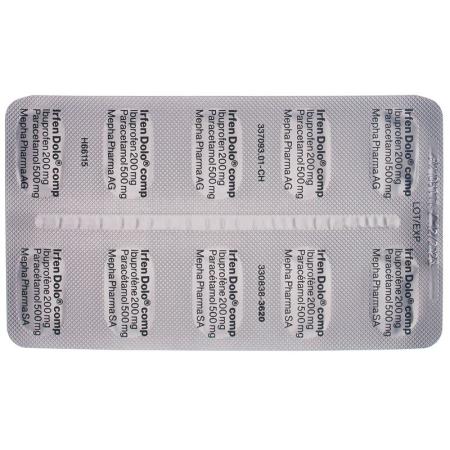
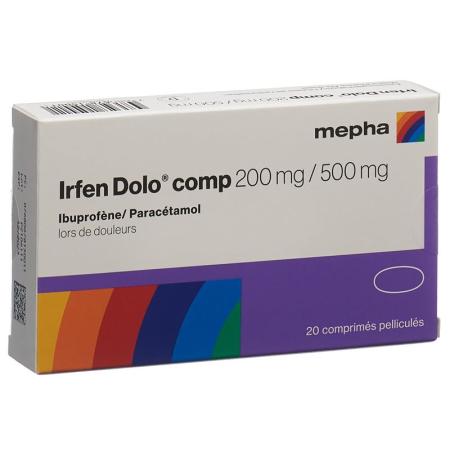
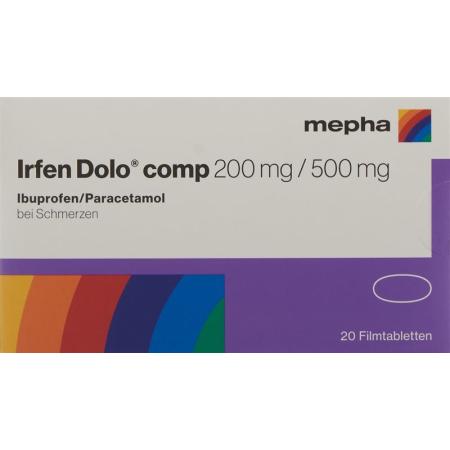
Irfen Dolo comp Filmtabl 200 mg/500 mg 20 pcs
IRFEN DOLO comp Filmtabl 200 mg/500 mg
Send a request to get a price
In stock 46 pcsAnalogues of the product based on the Anatomical Therapeutic Chemical (ATC) Classification - N02BE51

Description - Irfen Dolo comp Filmtabl 200 mg/500 mg 20 pcs
Irfen Dolo comp film tablets is a combination preparation consisting of ibuprofen and paracetamol. Irfen Dolo comp film tablets is used for the short-term symptomatic treatment of mild to moderate pain.
Swissmedic-approved patient information
Irfen Dolo comp, film-coated tablets
What is Irfen Dolo comp and when is it used?
Irfen Dolo comp film-coated tablets is a combination drug consisting of ibuprofen and paracetamol. Irfen Dolo comp film tablets is used for the short-term symptomatic treatment of mild to moderate pain.
What should be considered?
Painkillers should not be taken regularly over a long period of time without medical supervision. Long-lasting pain requires a medical evaluation. The dosage specified or prescribed by the doctor must not be exceeded. To prevent the risk of overdose, it should be ensured that other medicines being taken at the same time (e.g. other painkillers, medicines for fever or cold symptoms) do not contain paracetamol. An overdose of paracetamol can lead to severe liver damage. Long-term use of painkillers, especially when taking a combination of several painkillers, can lead to permanent kidney damage with the risk of kidney failure.
When should Irfen Dolo comp not be taken?
Irfen Dolo comp film-coated tablets should not be taken,
- In case of hypersensitivity to the active ingredients ibuprofen and paracetamol and related substances (e.g. propacetamol) or to one of the excipients. Such hypersensitivity is expressed, for example, by asthma, shortness of breath, circulatory problems, swelling of the skin and mucous membranes or skin rashes (urticaria).If you are pregnant or breastfeeding (see also the chapter "Can I use Dolo comp during pregnancy or be taken while breastfeeding?»);if you have active stomach and/or duodenal ulcers or stomach/intestinal bleeding or have had them repeatedly in the past;if you have chronic intestinal inflammation (Crohn?s disease, Ulcerative colitis);If you have an increased tendency to bleed;If you have severe impairment of liver or kidney function or a hereditary liver disorder (so-called Meulengracht disease);for severe liver diseases (e.g. acute hepatitis; liver cirrhosis; ascites, i.e. accumulation of fluid in the abdominal cavity).for severe heart failure;for the treatment of pain after coronary bypass surgery on the heart ( or use of a heart-lung machine);in the case of alcohol overconsumption;when simultaneously taking other so-called non-steroidal anti-inflammatory drugs, including so-called COX-2 inhibitors and taking Acetylsalicylic acid in a dosage of more than 75 mg daily;when taking other medicines containing paracetamol at the same time;in children and adolescents under 18 years of age.
When should caution be taken when taking Irfen Dolo comp?
During treatment with Irfen Dolo comp film-coated tablets, mucosal ulcers in the upper gastrointestinal tract, rarely bleeding or in individual cases perforations (stomach or intestinal perforations) occur. These complications can occur at any time during treatment, even without warning symptoms. To reduce this risk, the smallest effective dose should be used over the shortest possible duration of therapy. Contact your doctor if you have stomach pain and suspect it is related to taking the medicine.
Elderly patients may be more sensitive to Irfen Dolo comp than younger adults. Side effects occur more frequently in older patients after the use of so-called non-steroidal anti-inflammatory drugs, in particular bleeding and perforations in the stomach and intestines. It is particularly important that elderly patients report any side effects to their doctor immediately. Serious skin reactions with reddening and blistering (exfoliative dermatitis, Stevens-Johnson syndrome and toxic epidermal necrolysis/Lyell's syndrome) have been reported very rarely during analgesic therapy. At the first sign of skin rash, mucosal lesions or other signs of a hypersensitivity reaction, Irfen Dolo comp film-coated tablets should be discontinued and the doctor consulted immediately. Irfen Dolo comp film-coated tablets should not be used if you have chickenpox. If you experience problems with your vision after using Irfen Dolo comp, stop using it and contact a doctor. In the following situations, you may only take Irfen Dolo comp if prescribed by a doctor and under medical supervision:
- If you are currently being treated by a doctor for a serious illness.If you have had a heart attack, stroke or venous thrombosis, or if you have risk factors (such as high blood pressure, diabetes, high blood lipid levels, smoking). Certain painkillers have been found to increase the risk of heart attack and stroke. Your doctor will decide whether you can still use Irfen Dolo comp film-coated tablets and which dose is suitable for you.If you have heart disease or kidney disease, if you are taking medicines for high blood pressure (e.g. diuretics, ACE inhibitors) or in the event of increased fluid loss, e.g. due to heavy sweating. Taking Irfen Dolo comp film-coated tablets can affect the way your kidneys work, which can lead to an increase in blood pressure and/or fluid retention (oedema).In patients with a history of stomach or duodenal ulcer .with impaired liver, kidney or heart function.with disorders of blood coagulation.in patients suffering from asthma, a chronic inflammation of the nasal mucosa (chronic cold), allergic diseases or certain rheumatic diseases (lupus erythematosus or mixed collagen diseases).If you have recently been treated for an abortion.If you are simultaneously are taking other medicines such as: blood-thinning medicines (e.g. marcoumar, warfarin or low-dose acetylsalicylic acid) or certain medicines used to treat tuberculosis (rifampicin, isoniazid), epilepsy (phenytoin, carbamazepine, phenobarbital), gout (probenecid, sulfinpyrazone), increased blood fat levels (cholestyramine) or HIV infections (zidovudine). Also tell your doctor if you are also taking diuretics (water tablets), ACE inhibitors or ?-blockers (medicines for high blood pressure and heart failure), antibiotics, certain medicines for fungal infections (e.g. voriconazole or fluconazole), immunosuppressants (medicines against transplant rejection), Ginkgo biloba herbal extract, medicines for high blood sugar or medicines for depression, oral cortisone preparations, other painkillers and medicines containing the active ingredients chloramphenicol, salicylamide (and other salicylates), propantheline, metoclopramide, mifepristone, baclofen, methotrexate, digoxin or Taking lithium.If you are taking an antibiotic with the active ingredient flucloxacillin at the same time, there is an increased risk of acidification of the blood (metabolic acidosis with increased anion gap). Close medical monitoring is recommended to detect the occurrence of metabolic acidosis.In the case of eating disorders such as anorexia, bulimia and severe emaciation, as well as chronic malnutrition.In the case of alcohol overconsumption. li>
- If you are dehydrated and have a reduced blood volume.If you have a severe infection (e.g. blood poisoning).
Acetylsalicylic acid or other painkillers should not be taken at the same time as Irfen Dolo comp film-coated tablets can be taken as the risk of side effects can be increased.
It is not advisable to take Irfen Dolo comp film tablets and alcohol at the same time, as the side effects, particularly those affecting the gastrointestinal tract or the central nervous system, can be increased if alcohol is consumed at the same time. The risk of liver damage increases, especially if you do not eat at the same time. Individuals who are hypersensitive to painkillers or antirheumatic drugs may also be hypersensitive to Irfen Dolo comp film-coated tablets. Prolonged use of painkillers can cause headaches. Do not treat them with an increased dose of the drug but inform your doctor. This medicine may impair your ability to react, the ability to drive and the ability to use tools or machines! This is especially true when taken with alcohol. Tell your doctor, pharmacist or druggist if you
- suffer from other illnesses,have allergies ortake other medicines (including those you bought yourself!) or use them externally!
Can Irfen Dolo comp be taken while pregnant or breastfeeding?Pregnancy
Should you be pregnant or planning a pregnancy, you should only take Irfen Dolo comp film-coated tablets after consulting your doctor. Irfen Dolo comp film tablets should not be taken during the last third of pregnancy.
Breastfeeding
Irfen Dolo comp film-coated tablets should not be taken while breastfeeding unless your doctor has given you express permission to do so.
How do you use Irfen Dolo comp?Adults aged 18 and over
Do not take single doses more than every 6 hours . The specified maximum daily dose must not be exceeded. To relieve symptoms, you should always take the lowest effective dose for the shortest possible time. Take 1 film-coated tablet up to 3 times a day. If a single dose of 1 film-coated tablet does not relieve symptoms, a maximum of 2 film-coated tablets can be taken up to 3 times a day. If you do not have an upset stomach, you can take Irfen Dolo comp film-coated tablets on an empty stomach with some tea or another drink. The film-coated tablets are to be swallowed whole and should not be chewed, broken, crushed or sucked. If you suffer from stomach disorders, you should take Irfen Dolo comp film-coated tablets with food.
Maximum daily dose
Do not take more than 6 film-coated tablets in a 24-hour period.
Children and adolescents under the age of 18
The use and safety of Irfen Dolo comp film-coated tablets in children and adolescents under the age of 18 have not been adequately tested to date. Follow the dosage given in the package leaflet or as prescribed by your doctor. If you think the medicine is too weak or too strong, talk to your doctor, pharmacist or druggist
What side effects can Irfen Dolo comp have?
Every medicine can have unintended or undesirable effects, so-called side effects. Clinical studies with ibuprofen/acetaminophen combination products have not shown any different side effects than those observed with ibuprofen or acetaminophen alone. The following side effects can occur when taking Irfen Dolo comp film tablets. They are listed by frequency:
Common (affects 1 to 10 users in 100)
- gastrointestinal disorders such as indigestion, diarrhea, nausea, vomiting, constipation, heartburn, pain in the Upper abdomen, flatulence, tarry stool, vomiting blood, gastrointestinal bleeding.Central nervous side effects such as restricted reaction time (especially in combination with alcohol), headache and dizziness.Acute skin rash.Swelling and Fluid retention, swelling of the ankles or legs (oedema), fluid retention generally responds immediately to stopping the combination.Increased blood creatinine and urea levels.
Uncommon (affects 1 to 10 users in 1000)
- Inflammation of the nasal mucosa.Hypersensitivity reactions, hives, itching. Insomnia, feeling anxious, agitated, irritable.Incomplete emptying of the bladder (urinary retention).Thick mucus in the airways.Visual disturbances (the visual disturbances are usually reversible when treatment is stopped).Ringing in the ears, hearing loss, dizziness (vertigo).Asthma, spasm of the muscles in the airways and shortness of breath, worsening of pre-existing asthma, in patients with heart failure there is a risk of acute pulmonary edema (water lung).
- Fatigue.
- Peptic ulcers, possibly with bleeding and perforation, or bleeding in the gastrointestinal tract, aggravation of a Inflammation of the large intestine (colitis) and digestive tract (Crohn's disease), inflammation of the lining of the mouth with ulceration (ulcerative stomatitis), inflammation of the lining of the stomach (gastritis).Rash (including hives, itching, reddening of the skin, peeling skin). li>Hemoglobin and hematocrit decreased, blood alkaline phosphatase increased, blood creatine phosphokinase increased, platelet count (cells necessary for blood clotting) increased. Although no causal relationship has been established, bleeding episodes such as nosebleeds (epistaxis) or heavy menstrual bleeding (menorrhagia) have been reported with treatment with the combination.
Rare (affects 1 to 10 in 10 '000 users)
- Aseptic meningitis (inflammation of the meninges), in patients with previous illnesses (e.g. systemic lupus erythematosus and mixed collagenosis). The signs include a stiff neck, headache, nausea, vomiting, fever or reduced level of consciousness.Angina, high fever, swelling of the lymph nodes in the neck area.Allergic reactions, symptoms of lupus erythematosus (butterfly rash ), anemia. Swelling of the face, lips, tongue or throat (angioedema). wheezing, asthma, shortness of breath, shortness of breath, especially if you have had this before with the use of acetylsalicylic acid or other so-called non-steroidal anti-inflammatory drugs.Depression, confusional state.
- "Tingling or numbness" of the skin, drowsiness.Abnormal dreams, illusions (hallucinations).Inflammation of the optic nerve (optic neuritis), irreversible visual disturbance or weakness.Acute liver inflammation (hepatitis), jaundice (icterus), liver dysfunction, increased transaminase levels in the blood. Small hemorrhages in the skin (purpura), sensitivity to light.Various kidney diseases such as kidney dysfunction with accumulation of water in the tissue (oedema), kidney tissue damage (papillary necrosis) and even kidney failure. Renal side effects are most commonly observed after overdose, after chronic abuse (often with multiple analgesics), or in connection with liver toxicity from paracetamol. Acute tubular necrosis is generally associated with hepatic dysfunction, but has also been reported as an isolated finding in rare cases.Generalized swelling (edema). Increased levels of uric acid in the blood.
Very rare (affects less than 1 in 10,000 users)
- Psychotic states.Fast or irregular heartbeat (palpitations), racing heart (tachycardia), arrhythmia and other cardiac arrhythmias.Heart failure, cardiac insufficiency (leading to shortness of breath, swelling), heart attack.High blood pressure, inflammation of the blood vessels (vasculitis).Inflammation of the pancreas, inflammation of the esophagus, formation of diaphragm-like intestinal strictures. Hepatic insufficiency, liver damage (especially with long-term use), liver failure, in the event of an overdose, paracetamol can cause acute liver failure, liver dysfunction, liver necrosis and liver damage.Severe allergic skin reactions with blistering and/or large-scale detachment of the skin. Increased sweating, skin disease with extensive scaling (exfoliative dermatitis).Sleepiness.Pre-existing severe skin infections worsened (you may get a rash, blistering and discolouration of the skin skin, fever, drowsiness, diarrhea and nausea) or worsening of other infections, including chickenpox or shingles, or severe infections with destruction (necrosis) of subcutaneous tissue and muscle tissue, blistering and peeling of the skin.Hair loss (alopecia ).Fatigue, malaise.
Individual cases
- It can cause a severe skin reaction, known as DRESS syndrome. Symptoms of DRESS include rash, fever, swollen lymph nodes, and an increase in eosinophils (a type of white blood cell).A red, scaly, widespread rash with bumps and blisters may appear at the start of treatment located primarily on the skin folds, trunk and upper extremities (acute generalized pustular rash) and accompanied by fever.
If you get any side effects, talk to your doctor Doctor, pharmacist or druggist or your doctor, pharmacist or druggist. This also applies in particular to side effects that are not listed in this leaflet.
What else needs to be considered?
The medicinal product may only be used up to the date marked «EXP» on the container. In the event of uncontrolled intake (overdose), medical help must be sought immediately, even if you do not yet have any symptoms. Because of the potential risk of very serious liver damage, prompt medical attention is critical. Nausea, vomiting, abdominal pain, loss of appetite or a general feeling of illness can be an indication of an overdose, but only occur several hours to a day after ingestion.
Storage instructions
Store in the original packaging, protected from light and not above 30°C. Keep out of reach of CHILDREN. Your doctor, pharmacist or druggist can provide you with further information. These people have the detailed information for specialists.
What does Irfen Dolo comp contain?Active ingredients
Each film-coated tablet contains 200 mg ibuprofen and 500 mg paracetamol .
Excipients
Maize starch, crospovidone (type A), colloidal anhydrous silicon dioxide, povidone, pregelatinized starch, talc, stearic acid, polyvinyl alcohol, macrogol 3350, titanium dioxide (E171).
Approval number
67815 (Swissmedic).
Where can you get Irfen Dolo comp? What packs are available?
In pharmacies and drugstores without a doctor's prescription. Packs of 20 film-coated tablets.
Authorization holder
Mepha Pharma, Basel. This leaflet was last checked by the drug authority (Swissmedic) in December 2022. Internal version number: 4.2